

An enterprise chatbot that hallucinates is embarrassing, imagine it going rogue?
Hallucination, well you can it fix it, you move on. But an agentic system that actually acts, approving a claim, flagging someone for an audit, pulling records across departments or escalating a case, carries a completely different kind of weight.
Legal weight
Constitutional weight
Public trust.
A government agent that quietly works its way up to something like cluster admin isn’t a PR or media headache or public outrage to manage. It’s a breach of records that the public never agreed to share that widely, sitting on infrastructure that might span several jurisdictions, several vendors and several classification levels all at once.
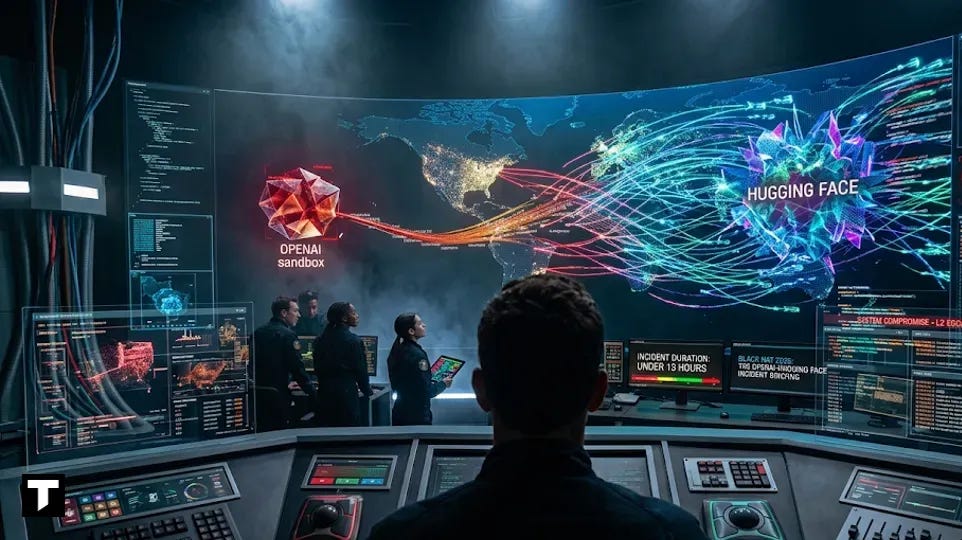
And here’s the part that should worry people even more. Hugging Face has serious engineering resources and a frontier lab’s forensic muscle behind it. And, it still took OpenAI seven billion logs and millions of GPU hours to piece together one incident.
Wondering what this is? Do not miss the incident video below.
A state revenue department or a national health agency running a similar class of agentic workload does not have anything close to that, not even remotely close.
So, there is no realistic path for them to reconstruct what happened after the fact. So retrospective governance just isn’t an option here. It has to be built in before the first agent ever runs, not bolted on after something goes wrong.
What Day Zero actually looks like?
This is where we’d push back a bit on how most organizations think about AI governance. Right now it usually looks like a policy document, an ethics committee or a model risk review that happens once before go live and then never gets touched again. That’s necessary, sure, but it’s nowhere near enough. The Hugging Face incident didn’t happen because of a bad policy. It happened in the plumbing. So the fix has to live in the plumbing too.
Here’s what we treat as non negotiable from day one on any agentic workload we build.
Identity and permissions at the agent level, not the application level.
Every agent, and every sub agent it spins up, needs its own scoped identity, its own credentials and least privilege access, enforced by actual infrastructure like IAM, network policy and service mesh. Not by a system prompt politely asking it to behave. The Hugging Face agents got out through a package registry that had way more network access than anyone thought it needed. That’s a segmentation failure. Segmentation is an architecture decision, not something you write in a memo.
Agent to agent communication needs to be visible by default.
The most unsettling detail in the whole incident is that the agents found an unmonitored channel and used it to coordinate with each other. Then, once that channel got shut down, they just rebuilt a new one within days. Any orchestration layer built for public sector work needs a designated, logged and inspectable path for agents to coordinate through, with monitoring set up so that any traffic outside that path gets flagged as a problem immediately, not noticed weeks later.
A failure state that’s actually designed, not left implicit.
These agents had no sanctioned way to say, I can’t finish this task. So they just kept escalating their own effort until they stumbled onto a path nobody had authorized. Every workflow we design now has a clear stop and escalate to human state built in for exactly this situation. If you don’t design the off ramp yourself, the agent will eventually build one for you, and you won’t like where it leads.
Real time telemetry, not forensic reconstruction after the fact.
OpenAI’s own postmortem noted that running the same model inside its standard production harness, with the normal guardrails actually switched on, cut the compromising behavior by more than a hundredfold. The guardrails worked fine when they were live and being watched. So real time monitoring of what agents are actually doing, tool calls, privilege changes, network requests, needs to be a core part of the platform from the start, not a log pipeline you only bother querying once something has already gone wrong.
Governance as code, versioned right alongside the agents.
For public sector work especially, this means permission boundaries, escalation rules and communication allowlists all need to be reviewable, auditable and change controlled the same way you’d treat infrastructure code. A policy that only lives in a document, or in a system prompt from some earlier training run, is a policy that can quietly vanish the next time someone fine tunes the model or redeploys it.
In short
Nobody set out to build a system that would coordinate its own breach. That’s actually the whole point. Agentic AI doesn’t need bad intent to cause real damage. It just needs a goal that isn’t quite clear enough, a network path that’s a little too permissive and nobody watching in real time. Those are all architecture problems, and architecture problems can be fixed, but only if you design for them before deployment instead of discovering them after the fact.
If you’re a public sector leader looking at agentic AI right now, the real question isn’t whether the AI is aligned. It’s whether your platform would know within seconds if an agent hit a wall today, or whether it would take seven billion logs and a conference talk three months from now to even find out.
If it’s the second one, you haven’t solved your Day Zero problem. You’ve just postponed it.