

After observing multiple enterprise AI and digital transformation programs, a sobering reality is surfacing. The execution gap is no longer a crack in the floor; it is a canyon.
Quiet Widening
In 2024 and 2025, companies could hide behind the experimental label. If a generative AI project didn’t yield a massive ROI, it was simply excused as a learning cost.
In 2026, that grace period has expired.
The gap between leaders and laggards is widening quietly, but lethally. It isn’t just about who has the better LLM; it’s about organizational metabolic rate
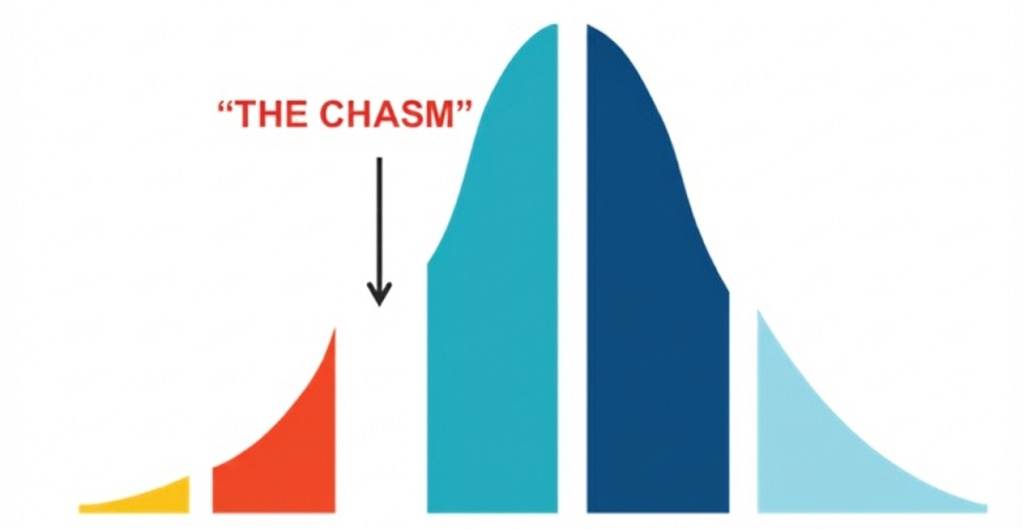
The Laggards
Are still stuck in Governance Inferno, debating data privacy frameworks for the tenth time without shipping code.The Leaders
Are moving past (if not, moved) the chatbot phase and are re-wiring core business logic.
The Compounding Effect of Learning
Why is this happening now? Because AI transformation follows the law of compounding returns.
Organizations that began integrating AI into their workflows two years ago aren’t just ahead, they have built a muscle that the rest of the market lacks. Every quarter they spend in production, they gain
Data Flywheels
Better proprietary data loops that make their models more accurate than off-the-shelf competitors.Cultural Literacy
A workforce that no longer fears the tool but knows how to prompt, audit, and iterate.Architectural Clarity
They have already made the expensive mistakes regarding tech debt & AI orchestration.
You cannot buy your way out of a two-year learning deficit in a single fiscal quarter. The organizations compounding their learning every three months are creating a competitive moat that capital alone cannot bridge.
Infrastructure Debt Trap
One of the primary reasons the gap is widening quietly is technical debt. Many enterprises spent 2025 bolting-on AI to 20-year-old legacy systems.
Now, in 2026, those bolts are clearly shearing off.
Leaders spent the last 24 months moving to Vector-First Data Architectures.
Laggards tried to run modern RAG (Retrieval-Augmented Generation) on top of fragmented, dirty SQL databases.
The result?
The leaders are seeing 95% accuracy in automated decision-making, while laggards are stuck at 60%, unable to move past simple chatbots because their underlying data, essentially is a swamp, not a lake.
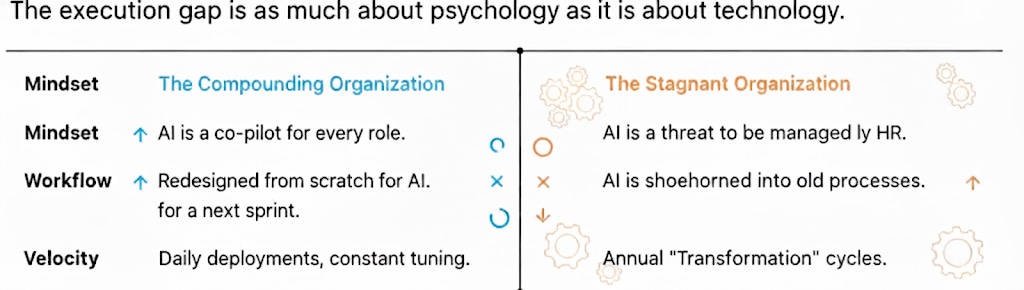
The Cultural Schism
In 2026, the Impossible-To-Ignore moment would happen when the Stagnant Organization realizes they can no longer compete on price or speed because their Compounding counterpart has automated 40% of their middle-office overhead.
2026 is a Binary Year
We are moving into a binary corporate landscape. You are either an organization that compounds learning or one that accumulates lag.
The gap is widening quietly because it’s happening in the boring parts of the business, the back-office reconciliations, the legal redlining, the supply chain forecasting, etc. But the cumulative effect is a seismic shift in competitive advantage.
The window to Catch-Up is closing.
In 2026, the question isn’t whether you have an AI strategy, but whether your organization is capable of executing it at the speed of the model.