

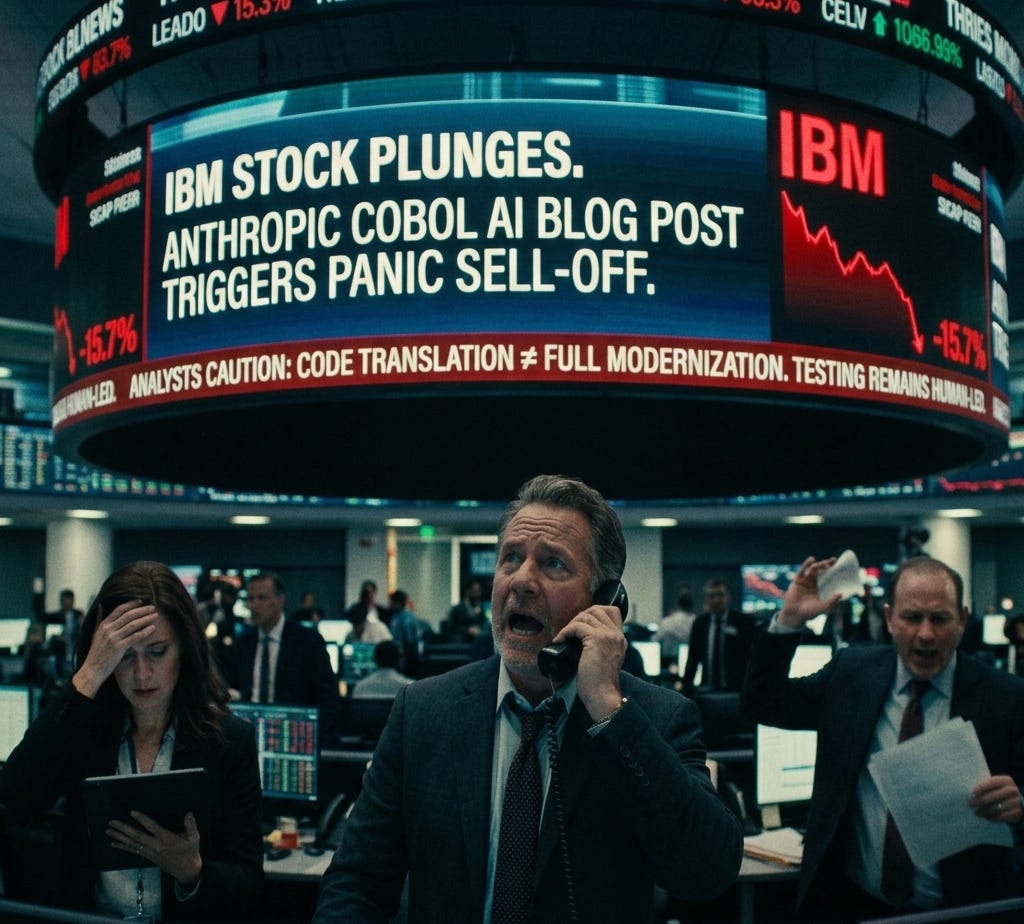
Imagine waking up to find that a brief corporate blog post, lacking any verified case studies, just erased 30 billion dollars from your company market cap. That is precisely the reality IBM faced this week.
Back in the early days of machine translation, engineers famously fed a system the phrase out of sight, out of mind. The system translated it into Russian &then back to English.
While AI has improved exponentially since those early days, the underlying lesson remains identical. Translating the words is not the same as understanding the entire ecosystem.
When Anthropic announced that its Claude Code AI could seamlessly read and translate 67-year-old COBOL into modern languages, the market reacted as if the entire mainframe industry had been rendered obsolete overnight. Investors hit the panic button, triggering a massive selloff of IBM stock.
However, as industry veterans quickly pointed out, translating a legacy language is only a fraction of the actual modernization battle.
Anatomy of an Overreaction
It is completely understandable why the market panicked initially. COBOL is the invisible backbone of the global economy, quietly powering 95 percent of ATM transactions and 80 percent of in-person credit card swipes. Because the original developers are retiring and universities no longer teach the language, maintenance costs are skyrocketing.
An AI tool that promises to automate this massive technical debt sounds like a fatal blow to the consulting revenues of legacy tech giants. However, analysts at Reuters, VentureBeat, and The Futurum Group rapidly poured cold water on the hype.
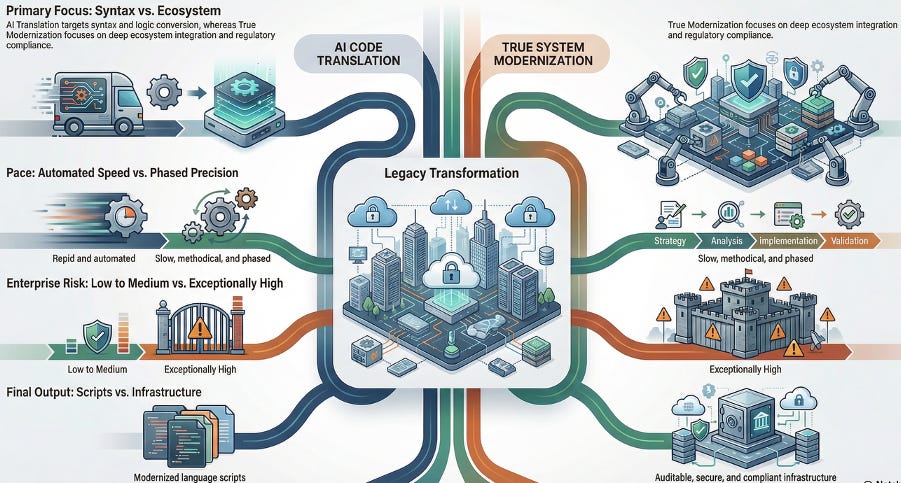
The fundamental error driving the market panic is the conflation of code translation with platform modernization. Anthropic Claude Code can absolutely map dependencies and translate legacy COBOL syntax into Java or Python. But IBM has already been offering a similar AI tool, watsonx Code Assistant, since 2023. The true bottleneck in mainframe modernization has never been just rewriting the code.
The Real Bottlenecks of Modernization
Translating syntax is fast, but deploying an enterprise-grade financial system is slow, methodical, and heavily reliant on human expertise. Here is why the migration process remains human-led.
Hardware Coupling
Decades-old COBOL applications are tightly integrated with the underlying mainframe hardware to achieve high-speed transaction processing. Simple code translation cannot replicate this optimized performance.
Behavioral Equivalence
Financial institutions require rigorous validation. A modernized system must process billions of transactions exactly the same way the old system did, down to the microsecond, to avoid catastrophic accounting errors.
Regulatory Audits
AI cannot sit in a room with government regulators to explain compliance protocols. Every step of a financial migration requires extensive audit trails and human accountability.
Ecosystem Integration
Legacy code does not operate in a vacuum. It interacts with thousands of external databases and partner systems that also need careful, strategic realignment.
Translation vs. Modernization
Your Next Strategy Meeting
Here are a few core takeaways to keep your team grounded when the next AI disruption narrative hits the news cycle.
AI can change the syntax, but human engineers must manage the system.
A translated codebase without structural integration is simply a fast track to a broken ecosystem.
The stock market loves a disruption narrative, but enterprise reality runs on audits, security, and compliance.
In Essence
The recent Anthropic announcement is a phenomenal showcase of how rapidly AI coding capabilities are advancing.
Tools that automate exploration and analysis will undeniably save thousands of hours in legacy migrations. But until an AI can sign off on a compliance audit or seamlessly untangle a 60-year-old hardware dependency, true modernization will remain a human-directed endeavor.
Do not let a sell first, ask questions later market trend distract you from the complex fundamentals of enterprise engineering.