

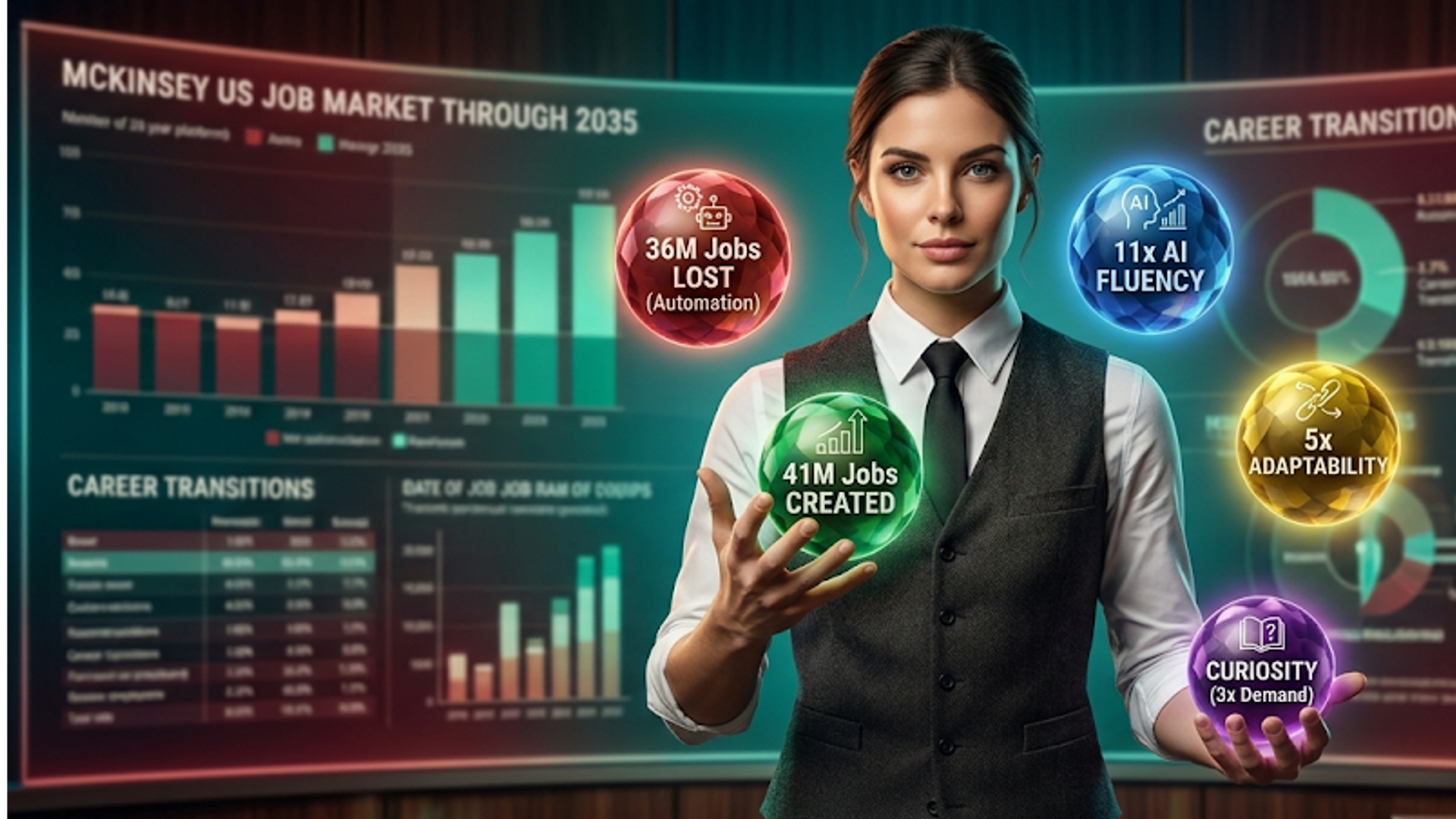
Here is a statistic that rarely goes viral. McKinsey Global Institute estimates that over the next decade automation could cut US labor demand by the equivalent of about 36 million jobs. The same research finds that AI and broader economic forces could create demand for more than 40 million jobs over the same period. The base case is a net gain of roughly five million jobs.
That is the contrarian note. The loudest predictions say the machines are coming for everyone, and the most careful research available says the economy is more likely to have more work in 2035 than it has today.
This is not a case for relaxing. The risk to jobs is clear and present, and for some roles it has already arrived. The larger danger for most people reading this is quieter: carrying on as if the work will stay the same. The research is neither bright nor bleak. The future it describes is a demanding one, and it rewards people who move early.
What the research says
The report is called Workforce in Motion and was published on September 29, 2026. Its numbers are model outputs under stated assumptions, not measurements, so they are best read as directional. Even so, the findings are specific.
Automation could absorb about 54 percent of current US work hours by 2035. That does not mean 54 percent of jobs vanish. Four forces soak up most of the blow. Overworked professions use AI to return to sustainable hours. Cheaper work creates more demand for it. AI generates new tasks such as reviewing and supervising its own output. Regulation and organizational inertia slow displacement. Together these offset roughly 60 percent of the impact, leaving a net reduction in labor demand of about 21 percent of work hours. Demographic change, infrastructure spending and the build-out of the digital economy then add demand on top.
Of the 36 million jobs hit by reduced demand, about 25 million are absorbed within the same occupations, where growth elsewhere in the field offsets the loss. The remaining 11 million workers, about 7 percent of current employees, may need to move into entirely different occupations. Depending on how fast adoption runs, that figure ranges from six million to 16 million.
Three findings stand out.
The pain is concentrated. More than 75 percent of the workers who may need to switch occupations sit in three groups: office and administrative support, retail and sales, and transportation and logistics. Customer service representatives, cashiers and warehouse workers feature heavily.
Growth is concentrated too. Healthcare, construction and management lead. Roughly 57 percent of growing employment sits in the top two wage quintiles, while more than 70 percent of declining employment sits in the bottom two. The economy sheds lower-wage work and adds higher-wage work.
A job existing is not the same as a worker being able to reach it. Only about one in seven transitioning workers has a direct pathway to a growing job. Four in ten face a winding route and nearly half an unpaved one. About 85 percent of growing jobs require some credential or certification, and these jobs ask for more skills than the ones they replace, an average of 68 against 47.
What it means for people in tech
Technology and analytics roles are among the most exposed. The report puts expected automation adoption in them at about 70 percent of current work hours. Read quickly, that is the headline that keeps engineers awake.
Read carefully, it says something different. Adoption is not displacement. The report notes that occupations in fields like engineering and management can see heavy automation of tasks with a much smaller drop in demand, because the freed time flows into augmentation, oversight and new work. Software hiring offers a live example. Postings for developers fell sharply from their 2022 peak, partly from pandemic-era overhiring and partly from AI automating coding tasks. Since early 2025 they have risen about 15 percent, and the gaps are in senior and AI-oriented roles. The market is not shrinking evenly. It is repricing skills.
The most useful idea in the report for a tech worker is reinvention. More than 70 percent of workers may see over 15 percent of their task time reallocated, whether their occupation grows, shrinks or holds steady. About a quarter could see more than 30 percent reshuffled. The typical outcome of the next decade is not a pink slip. It is the same job title wrapped around a different job.
The report’s cashier example shows how this plays out. The role is shrinking, yet the remaining cashiers are not doing a smaller version of the old job. They handle exceptions, deal with customers and oversee automated systems. An insurance underwriter spends less time gathering data and more time judging risk and explaining decisions. Headcount can fall and the work can get richer at the same moment.
Then there is the signal in the job postings. Between 2022 and 2026, employer demand for AI fluency rose about 11-fold. Demand for adaptability rose about fivefold, and demand for resilience, curiosity and willingness to learn roughly tripled. Employers are paying for the ability to keep changing, and AI fluency is only part of that.
The case for hope is also a case for urgency. Of those 11 million transitions, 770,000 workers a year would need to change occupational groups, about 3.6 times the historical pace. The economy can handle that if workers can move, and the research suggests they mostly can. Only about 3 percent of transitioning workers face a pay cut on their likely route. The work and the wages are there, but they go to those who prepare.
How to capitalise? Unlearn first, then Learn
Most advice starts with what to learn. I would start with what to drop.
Unlearn these four habits
Drop the habit of defining yourself by tasks.
If your identity is writing a certain kind of code, running a certain kind of report or producing a certain kind of document, you are tied to the part of the job most likely to be automated. Define yourself by the problems you solve and the outcomes you own.
Drop the wait-and-see posture.
The research is clear that two organizations with similar workforces can have very different adoption paths, which means your employer’s pace is not a forecast of your risk. Waiting for clarity is a decision, and it usually costs you the cheapest time to learn.
Drop the idea that learning ended with your degree.
Growing roles ask for more skills and more credentials, and the skills themselves keep turning over. Treat learning as a recurring cost of the job, like maintenance, and not as a one-off event.
Drop the habit of treating AI as a rival.
The workers the report describes as gaining mobility are those who learn to work with AI systems, redesign workflows and interpret machine output.
Learn these things, in this order
Start with AI inside your real work. Fluency does not come from courses alone. Pick the three most repetitive tasks in your week and rebuild each one with AI in the loop. Notice where the output fails, because that is where your judgment earns its keep.
Move toward the new work the report describes: reviewing, validating, handling exceptions and supervising automated systems. In tech this means testing and evaluating AI output, understanding failure modes, designing workflows around agents, and owning accountability for what ships. These roles grow as automation grows.
Build the skills the report calls enabling, such as decision-making, critical thinking and innovation. They are broadly applicable and concentrated in higher-paying work, and they are also among the least exposed to automation. Technical depth still matters, but depth combined with judgment and communication is what lets an engineer move toward product, architecture or leadership.
Work on the learning muscle itself. Curiosity, adaptability and resilience can look soft, yet the research treats them as skills that can be developed, and employers are already hiring for them. A simple practice works well: schedule a fixed weekly block for learning something unfamiliar and protect it the way you protect a deadline.
Finally, make your skills visible. The report notes that qualified people are often overlooked because hiring systems read credentials and job titles, not capability. Build a public record of what you can do through projects, write-ups and shipped work. If your target field requires a credential, find out early what is legally required and what is only preferred, since employers can often waive the second kind.
A simple ninety-day plan
In the first month, automate three of your own tasks and write down what you learned. In the second, take on one project that involves evaluating or supervising AI output, even a small internal one. In the third, pick one adjacent role you would want in three years, list the skills it asks for, and close the two biggest gaps. None of this needs permission or a large budget.
Lastly..
The research does not promise that everyone lands softly. Pathways are uneven, the transition is large, and the workers with the weakest routes need real support from employers and policymakers. But for a technology professional with a laptop, a salary and the ability to learn, the odds are better than the feed suggests.
The economy is likely to keep needing people who can think, decide and adapt alongside increasingly capable machines. The only version of this story that ends badly for you is the one where you decide the story is already written. Start this week, and start small.
The 3 percent facing a pay cut is reassuring until you put it next to the time the route takes. MGI's own figures have a legally required credential taking about 32 months for someone with a high school diploma, and the people most likely to need one are the ones with the least savings to cover those months. The wage at the end is fine for most of them. Getting there is where the support from your closing section has to go.
📌 Read more about the McKinsey & Company article here.
https://www.mckinsey.com/mgi/our-research/Workforce-in-motion-Skills-and-pathways-to-future-jobs-in-the-United-States