

CoreWeave sells computing power in a market where supply has been tight all year. Its list prices went up. Its contracted backlog passed $104 billion. Its shares still fell roughly 30% in October.
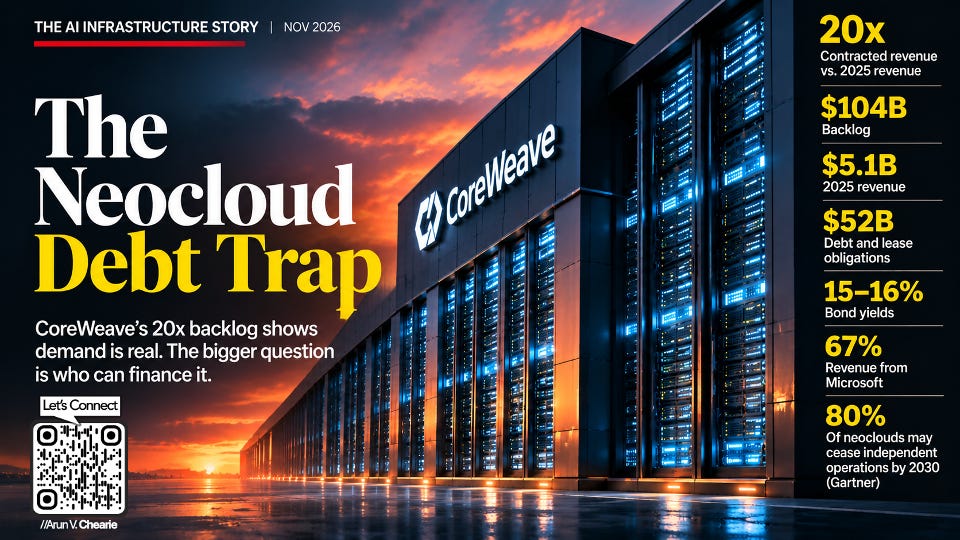
That gap between demand and market judgment explains the neocloud story better than any growth chart. The question has stopped being whether anyone wants the product. It is who carries the debt used to build it.
What a Neocloud is?
A neocloud is a cloud provider that does one thing: it rents graphics processors to companies that build and run AI models. Amazon, Microsoft and Google sell hundreds of services. A neocloud sells time on racks of Nvidia chips wired together for AI work. The best known are CoreWeave and Nebius, which trade on Nasdaq. Lambda and Crusoe are private. Crusoe said in June that its contracted capacity had reached 4.9 gigawatts across five US campuses.
The pitch to customers is price and availability. An August report in Seoul Economic Daily put neocloud GPU rentals up to 66% below the large incumbent clouds.
Where they came from?
CoreWeave’s founding story is the cleanest illustration. Michael Intrator, Brian Venturo and Brannin McBee started it in 2017 as Atlantic Crypto to mine Ethereum with Nvidia chips. Ethereum dropped mining in 2022. Mining still made up 61% of CoreWeave’s $15.8 million of revenue that year according to its IPO filing. The company then turned its stock of GPUs into a rental business.
The timing mattered more than the strategy. ChatGPT arrived in late 2022 and demand for GPUs outran supply almost at once. The hyperscalers could not build data centers fast enough. Nvidia also had its own reason to widen its customer base: its biggest buyers were increasingly designing their own chips. Nvidia joined CoreWeave’s $221 million round in April 2023 and kept backing it. Investors have long assumed that Nvidia’s backing buys neoclouds early access to new chips.
Why investors saw a sure thing?
Three features made the model attractive to equity and credit investors alike.
Scarcity. GPUs and the power to run them were the constraint on AI progress. SemiAnalysis found that one-year H100 contract prices rose almost 40% between October 2025 and March 2026 from $1.70 to $2.35 per GPU-hour. It also reported that all capacity coming online before late summer 2026 was already booked.
Contracts. Neocloud revenue rests on multiyear commitments from large buyers. Nebius says Microsoft must pay its fees whether or not it uses the capacity including about $7 billion upfront. CoreWeave’s backlog stood at $104.2 billion at the end of June, up 246% on the year. The backlog now includes Meta (up to roughly $35 billion across agreements) and OpenAI (up to about $22.4 billion) along with newer deals with Anthropic and Jane Street.
Financing. Lenders weigh the credit of a customer like Microsoft or Meta more heavily than the neocloud’s own balance sheet according to research from The Quiet Period. A Goldman Sachs analyst describes CoreWeave’s main funding as delayed-draw term loans: asset-backed project financings that are often largely repaid by the time a contract ends. Nvidia added a backstop. CoreWeave’s filing obliges Nvidia to buy any unsold capacity through April 2032. Nvidia also invested $2 billion in CoreWeave in January at $87.20 a share and $2 billion in Nebius for an 8.3% stake.
My reading is that a neocloud works more like a financing structure than a cloud. It borrows against another company’s credit to buy chips from a supplier that also holds its equity. That works while every link holds. It also means one shock can reach several links at once.
The flaws built into the model
Five weaknesses sit in the design rather than in any single bad quarter.
Customer concentration. Microsoft supplied about 67% of CoreWeave’s 2025 revenue. Three unnamed customers made up 24%, 21% and 14% of Nebius’s second-quarter revenue.
Customers who are also rivals. Microsoft and Meta are building their own capacity and can fund it from profits elsewhere. CoreWeave has relied on customer commitments and debt.
Thin differentiation. A GPU hour is close to a commodity. One May survey of 41 providers found a 12-fold price spread for the same H100 chip. Only CoreWeave commands a clear premium: SemiAnalysis puts it at 10% to 15% over peers on managed clusters.
Chip obsolescence. Several contracts run to 2031 or 2032. Nvidia has moved from the H100 to the B200 and then the B300 in about three years. Gartner warns that more than $3.5 trillion of AI infrastructure spending could face impairment by 2030 if providers keep up the current pace.
Dependence on Nvidia and on power. CoreWeave’s prospectus says all of its GPUs come from Nvidia. Backlog turns into revenue only after power is secured and hardware installed. Bernstein estimates that only 35% of announced North American data center capacity will get built.
Why they are so much in the news now?
Several things landed within a fortnight in October. On October 14 Gartner forecast that more than 80% of neocloud providers will cease independent operations by 2030. The same week investor Chamath Palihapitiya posted a chart showing CoreWeave’s bond yield touching 15%. CoreWeave shares fell 15.46% in a single session according to Fortune. The Financial Times then ran an interview in which CoreWeave co-founder Brannin McBee said he wanted to borrow more from insurers. The cost of insuring CoreWeave’s debt against default climbed to about 1,000 basis points. By late October the notes due 2030 to 2032 yielded 15% to 16%.
The stock lost roughly 30% in the month. TipRanks had it near $58.57 on October 20 against almost $138 in early May. The damage spread: IREN and CoreWeave fell about 5% and Nebius about 4% on the day of the Gartner report. Goldman Sachs upgraded CoreWeave to buy on October 19 and called the sell-off overdone.
What is going wrong?
The selloff did not follow a demand shock. Nebius raised its on-demand H100 price from $3.85 to $4.50 an hour on October 1. CoreWeave told Fortune that its backlog more than covers its debt. The trouble lies in the arithmetic of financing.
Debt against a small earnings base. CoreWeave carried about $52 billion of debt and lease obligations: $35.6 billion of debt and $16.3 billion of operating leases. Its 2025 revenue was about $5.1 billion with a net loss of $1.2 billion. In the second quarter revenue rose 112% to $2.58 billion and the company reported a loss of $626 million alongside a $128 million operating profit. One analyst noted that the loss roughly equals what CoreWeave paid its lenders.
Near-term maturities. About $7.5 billion of the debt sat in the current portion on June 30. One credit tracker put debt due within 12 months at 1.36 times cash.
Capital spending that outruns cash flow. Even the stronger operator shows the pattern. Nebius grew second-quarter revenue 454% to $582 million with operating cash flow of $2.3 billion and $8 billion of cash. It also spent $5.7 billion on capital projects in the quarter and guides to $20 billion to $25 billion for the year.
The price of money. Goldman’s analyst expects CoreWeave’s blended cost of debt to rise by 100 to 200 basis points. A business that borrows to build ahead of revenue is more sensitive to that than to the price of a GPU hour. Rising rental prices and rising interest costs can hurt and help in the same quarter.
What the future looks like?
Gartner’s forecast needs careful reading. The firm’s chief forecaster John Lovelock said it does not predict that these companies will go out of business. It says they may cease independent operations. In June the same firm projected that neoclouds would take 20% of a $267 billion AI cloud market by 2030. The two forecasts fit together: the group can gain share while the number of independent names shrinks. Investor Paul Kedrosky expects restructurings and points out that the chips and data centers survive when the equity does not. The Information reported that executives expect only seven to 10 of hundreds of neoclouds to survive.
My judgment is that three outcomes are most likely.
A few scaled operators with secured power and investment-grade contracts keep their independence. CoreWeave and Nebius are the obvious candidates though CoreWeave must show it can refinance at tolerable rates.
Weaker operators restructure or sell to hyperscalers or to infrastructure funds. Lenders and shareholders take the loss while the hardware keeps running.
Large customers pull more capacity in-house as their own data centers come online. That would hit concentrated names hardest.
What to watch over the next quarter:
Third-quarter results. CoreWeave, Nebius and IREN report this month. CoreWeave guided to revenue of $3.45 billion to $3.6 billion.
Bond yields and credit spreads. Whether the 15% yields ease is a better health signal than the share price.
Customer drawdowns. Whether Microsoft, Meta and OpenAI take capacity at the pace contracted.
GPU rental prices. SemiAnalysis notes that prices can rise for scarce Blackwell-era capacity while older tiers fall.
Insurers and private credit. Whether the new lenders McBee wants actually arrive.
Buyers of AI capacity should note one practical point.
A multiyear compute contract is also a bet on the supplier’s balance sheet because delivery depends on it.
Reading a neocloud’s debt schedule the way a lender would is now part of due diligence.