

There is a familiar story playing out across enterprises.
A team launches an AI pilot.
The demo looks impressive.
Users are excited.
Someone builds a polished interface, usage starts climbing and the project gets presented as evidence that the company is making progress with AI.
Then comes the difficult question.
What has actually improved in the business?
Has the cost of serving a customer fallen?
Are fraud losses lower?
Is a factory producing more with the same resources?
Are decisions getting better?
Has the time taken to resolve a claim come down?
These are the questions that separate AI activity from business value.
Adoption matters. A system nobody uses will not deliver much. But adoption is an early milestone, not the finish line.
The same goes for a beautifully simplified user interface. It can make a complex capability easier to use. It cannot fix a poorly chosen business problem, an unreliable workflow or a decision process that nobody has redesigned.
And setting an outcome target alone will not get you there either.
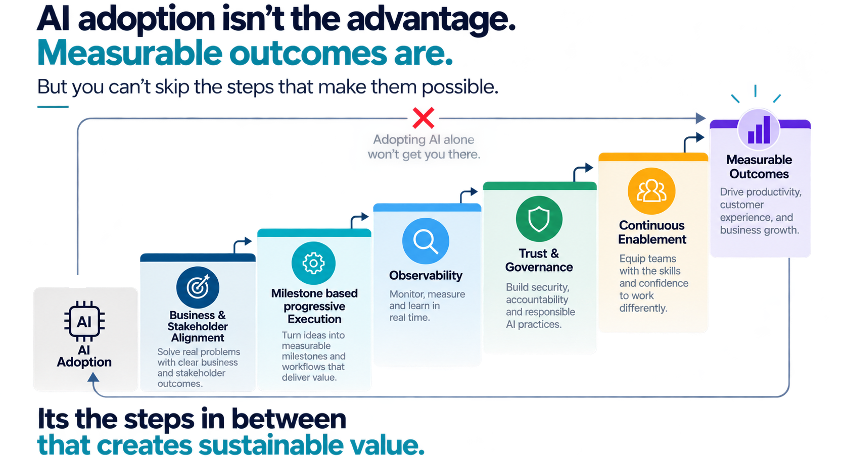
There is a reason the journey in the accompanying visual has several steps.
Start with the business, not the tech
AI projects often begin with a capability.
We have a new model. We can build an agent. We can automate this task. We can put a conversational interface over that application.
Those may be useful starting points for exploration. They are not yet a business case.
Consider a bank looking to reduce fraudulent transactions. A model that detects suspicious activity is only one part of the answer. The bank also needs to decide which transactions deserve attention, how quickly a case should be reviewed, when a payment should be blocked and how legitimate customers will be protected from unnecessary friction.
If the model improves detection but overwhelms investigators with false positives, the business may have traded one problem for another.
The first step is business and stakeholder alignment.
That means agreeing on the problem, establishing a baseline, identifying who owns the result and deciding how success will be measured. It also means bringing operations, technology, risk and business leaders into the same conversation before the solution gets too far ahead.
Without this agreement, teams can spend months optimising a technical metric that has little relationship to the outcome the business actually cares about.
Execution needs milestones, not a leap of faith
Once the problem is clear, the next challenge is execution.
Too many AI programmes are treated as if the path from a successful pilot to production were simply a matter of scaling the infrastructure.
It rarely works that way.
A pilot might perform well on a limited dataset and still struggle with live data, unusual cases, integration dependencies or the pace of actual operations. A workflow that looks efficient in a controlled demonstration can create bottlenecks when hundreds of employees start using it.
This is why milestone-based progressive execution matters.
Move from a controlled test to a limited production environment. Check performance against agreed criteria. Validate the integration with existing systems. Examine the exceptions. Expand only when the evidence supports it.
Each milestone should answer a business question.
Does the solution work under real operating conditions? Is the benefit large enough to justify the cost? Can the organisation manage the risks? Are the people using it getting the expected result?
The point is not to slow everything down with endless approvals. It is to discover problems while they are still manageable.
A failed experiment at a small scale can be useful. The same failure embedded in a critical business process can be expensive.
What you cannot observe, you cannot improve
There is another step that deserves more attention than it usually gets: observability.
A model can perform well when it is launched and deteriorate as customer behaviour, data quality or operating conditions change. An agent may complete most tasks correctly while quietly making a recurring mistake in a particular type of case. A workflow may appear faster overall while creating more rework downstream.
If the organisation measures only usage or the number of tasks completed, these problems can remain hidden.
Observability connects technical performance with operational reality.
It should help teams understand whether the system is behaving as expected, where errors are occurring, how often people intervene and whether the original business benefit is holding up over time.
For an AI-driven claims process, that could mean tracking processing time alongside error rates, escalation volumes and the percentage of claims that need manual correction.
For a fraud solution, it could mean examining detection quality alongside false positives, investigator workload and losses prevented.
The exact measures will vary. What matters is the connection between what the system is doing and what the business needs it to achieve.
Observability also creates a feedback mechanism. It gives teams evidence to refine the model, change a workflow or reconsider an assumption that looked sound during the pilot.
Without it, scaling can simply multiply an unnoticed problem.
Trust & Governance have to be built into the work
AI systems increasingly influence decisions that affect money, customers, employees and public services. In those settings, performance alone is not enough.
The organisation needs to know whether decisions can be explained, whether access to data is appropriate, whether sensitive information is protected and who is accountable when something goes wrong.
These questions cannot be postponed until the end of the programme.
Trust and governance need to develop alongside execution. Controls should reflect the consequences of the decisions being made. A tool that summarises an internal meeting does not require the same safeguards as a system that influences credit decisions or determines eligibility for a public benefit.
The practical challenge is to make governance part of the workflow rather than an obstacle bolted onto it.
That requires clear ownership, appropriate human oversight, auditability and a defined way to handle exceptions. It also requires the organisation to be honest about where AI is reliable and where a person must remain responsible for the decision.
A system that produces a good result most of the time can still create unacceptable risk if nobody is watching the cases where it fails.
Adoption is a continuing responsibility
There is one more gap between a working AI system and a successful business outcome: the people expected to use it.
A new system changes how work gets done. Employees may need to learn when to trust a recommendation, when to challenge it and when to override it. Managers may need to change performance measures and operating procedures. Teams may discover that the old division of responsibilities no longer makes sense.
Sending an announcement and conducting a training session will rarely address all of this.
Continuous enablement means helping people adapt as the system and the work evolve. It involves collecting feedback, improving the workflow, addressing resistance and making sure employees understand both the capabilities and the limits of the technology.
This matters because the benefits of AI often depend on changes in human behaviour as much as on model performance.
A claims assistant might draft a good assessment, but the value is lost if adjusters must spend as much time checking its output as they previously spent writing from scratch. A manufacturing copilot might recommend a better production schedule, but the recommendation will have little impact if planners cannot incorporate it into their daily decisions.
The system has to fit the work. The work may also need to change to take advantage of the system.
The loop matters as much as the steps
These stages are not a one-time checklist.
Business priorities change. Models drift. Regulations evolve. Employees find new ways to use a tool, including ways its designers did not anticipate. Costs rise or fall as usage grows.
That is why measurable outcomes should feed back into the process.
If a solution delivers less value than expected, revisit the business assumptions. If observability reveals a recurring failure, improve execution. If users keep overriding recommendations, investigate whether the model is wrong, the workflow is poorly designed or the team lacks confidence in the system.
A closed-loop approach gives the organisation a way to learn and adjust instead of declaring victory at launch.
It also changes how AI investment should be evaluated. The question is no longer simply whether a project made it into production. It is whether the value is real, whether it persists and whether the organisation can improve it over time.
That requires business leaders to stay involved after the technology team has delivered its solution.
Competitive advantage is in the work between the milestones
It is tempting to look for a shortcut.
A simpler interface. A more capable model. A larger deployment. An ambitious outcome target.
Each can help. None removes the need to connect the technology to the business, execute in manageable stages, observe what happens in production, govern the risks and enable people to work differently.
The organisations that get lasting value from AI will be the ones that take these steps seriously.
They will know what they are trying to improve before they start building. They will demand evidence as they scale. And they will keep working on the system after the launch announcement has faded.
AI adoption is visible. The work that makes it valuable is often less glamorous.
It is the steps in between that create sustainable value.