

It has been another whirlwind week in the world of Data and AI, and I’ve sifted through the noise to bring you the five most impactful developments.
The themes through the last two weeks are all about accelerating capabilities, from major model releases and the proliferation of “AI Agents” to a deeper, more hands-on regulatory push.
Below are the top stories.
The Frontiers Heat Up: GPT-5.2 and Gemini 3 Deep Think
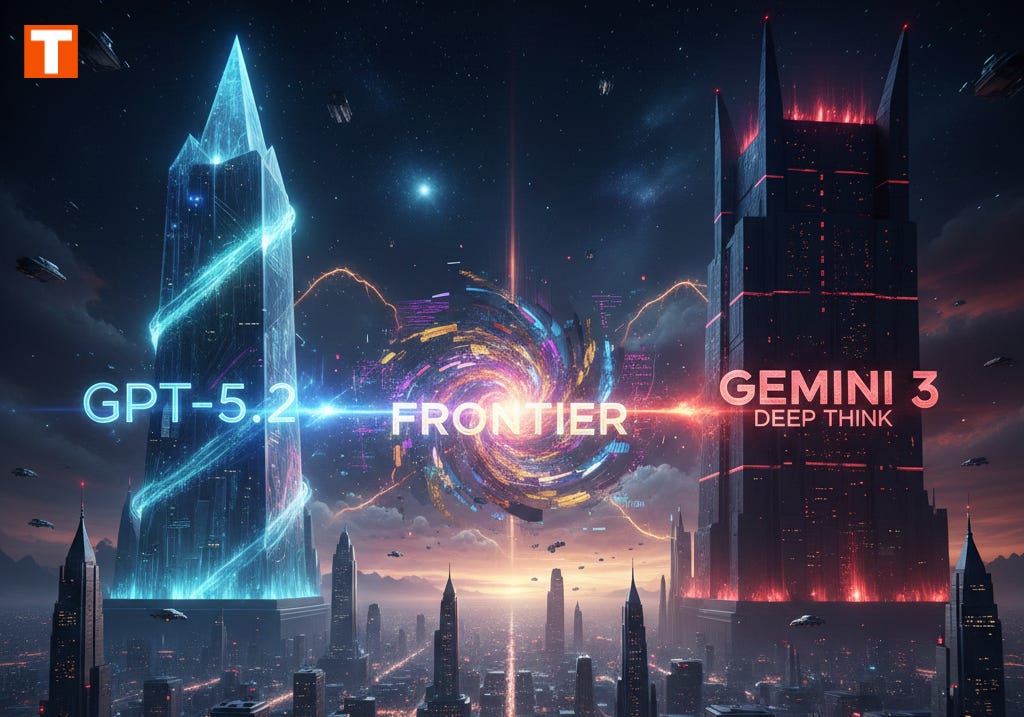
This week saw the competitive release of new, higher-capability models from the two titans of AI. OpenAI announced and released GPT-5.2 after what was reportedly an internal “code red” following strong benchmarking from its rival. OpenAI touts significant improvements in general intelligence, long-context understanding, and most critically, agentic tool-calling, which allows the model to better execute complex, multi-step, real-world tasks end-to-end.
Concurrently, Google began rolling out Gemini 3 Deep Think to its Ultra subscribers. This is described as a dedicated, high-precision reasoning mode focused on tackling long-form math, science, and multi-step logic problems.
My Take
This is classic platform-level competition. We’re moving beyond mere token-generation speed and quality; the battleground is now reasoning and agentic capability. The move to prioritize specialized reasoning modes, like Deep Think, and improved tool-calling (GPT-5.2) signifies that the goal is no longer just being a better chatbot, but a functional, multi-step co-pilot.
I believe the next 12 months will be defined by which company can successfully bridge the gap between “impressive demo” and “reliable, real-world automation tool” using these enhanced agents.
Agentic Goes Mainstream with New Tooling & Foundations

The concept of “AI Agents”, systems that can perceive, plan, act, and course-correct autonomously, is rapidly transitioning from a research concept to a deployable product. Two major developments below underscore this.
Google Workspace Studio Launch
Google introduced this AI automation hub, allowing non-developers to build powerful, natural-language agents for services like Gmail, Drive, and Chat. This puts true workflow automation directly into the hands of enterprise users.Linux Foundation forms Agentic AI Foundation (AAIF)
This new foundation aims to promote transparent and collaborative evolution of agentic AI, launching with significant project donations, including Anthropic’s Model Context Protocol (MCP) and OpenAI’s AGENTS.md
My Take
This is a profound shift in the development paradigm. Agentic workflows are now becoming the standard, not the exception.
The Linux Foundation’s move is particularly important standardizing protocols for agents is crucial for interoperability and safety. We need a common language and framework for these autonomous systems before they become too complex and fragmented. The barrier to entry for building powerful, automated workflows just dropped significantly, which means every organization needs to accelerate its strategy for AI-driven process optimization.
Neural Interfaces Blur the Line Between Biology and AI
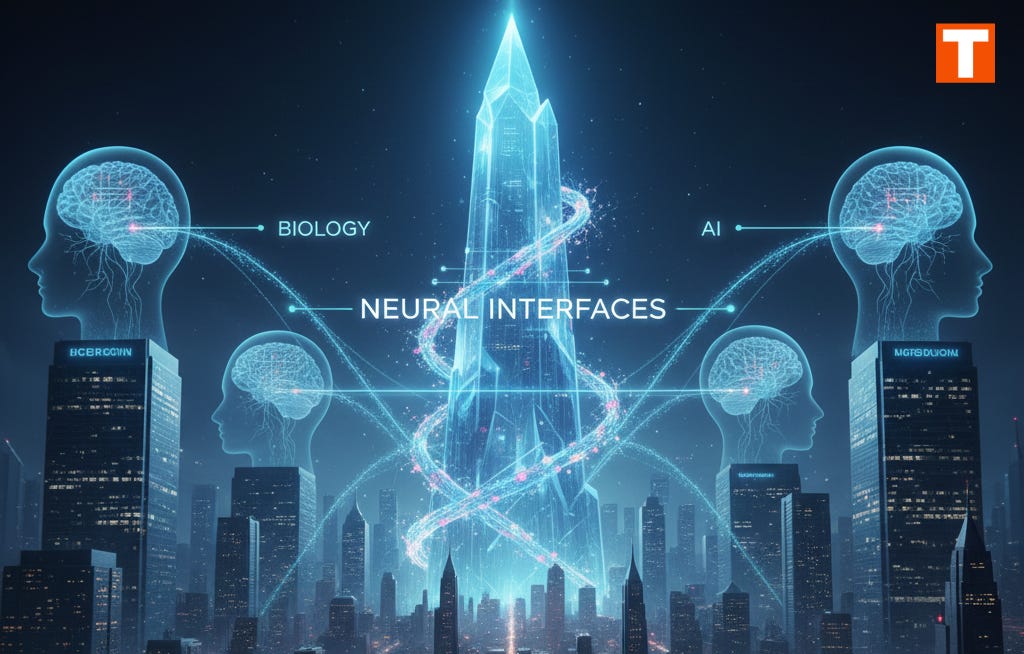
In the world of cutting-edge research, scientists demonstrated an incredible leap forward in brain-computer interfaces (BCIs). A new ultra-thin neural implant, called BISC, was revealed. This chip creates a high-bandwidth, wireless link between the brain and computers, packing tens of thousands of electrodes. Its primary immediate application is to use advanced AI models to decode human thoughts related to movement and perception in real-time.
Furthermore, a separate implantable device was created that sends light-based messages directly to the brain, showing that mice could learn to interpret these artificial patterns as meaningful signal.
My Take
This is a moment that feels pulled straight from science fiction. The real-time streaming of thoughts via BISC, coupled with the ability to “write” information into the brain using light-based signals, fundamentally challenges our understanding of human-computer interaction. While the ethical and security discussions are paramount, the potential for using these advancements to treat neurological disorders, restore motor function, and enhance communication is immense. The symbiotic relationship between hardware (the implant) and software (the AI decoding model) is the true innovation here.
The State of Enterprise AI: Productivity & Acceleration

OpenAI released a comprehensive report this week on “The State of Enterprise AI”, offering a data-backed look at how their models are being adopted across global organizations.
Measurable Productivity Gains
Workers using AI report saving an average of 40-60 minutes per day. Heavy users save over 10 hours per week.
Adoption is Deepening
Weekly messages in ChatGPT Enterprise increased approximately 8x over the last year, with a significant shift from casual querying to integrated, repeatable processes using custom GPTs and structured workflows.
New Capabilities
Crucially, 75% of users report being able to complete new tasks they previously could not perform, indicating AI is not just accelerating old work but enabling new forms of work.
My Take
The anecdotal evidence is finally being backed by hard numbers. The reported time savings are significant, but the real headline is the 75% figure for new tasks. This confirms what many of us in the field have suspected: AI is a tool for capability expansion, not just a productivity hack.
This report should be mandatory reading for CEOs and CTOs who are still in the “pilot project” phase, as it provides concrete evidence that the competitive advantage is rapidly shifting to those who operationalize AI at scale.
Geopolitics and Regulation: The US & China Chip Dance
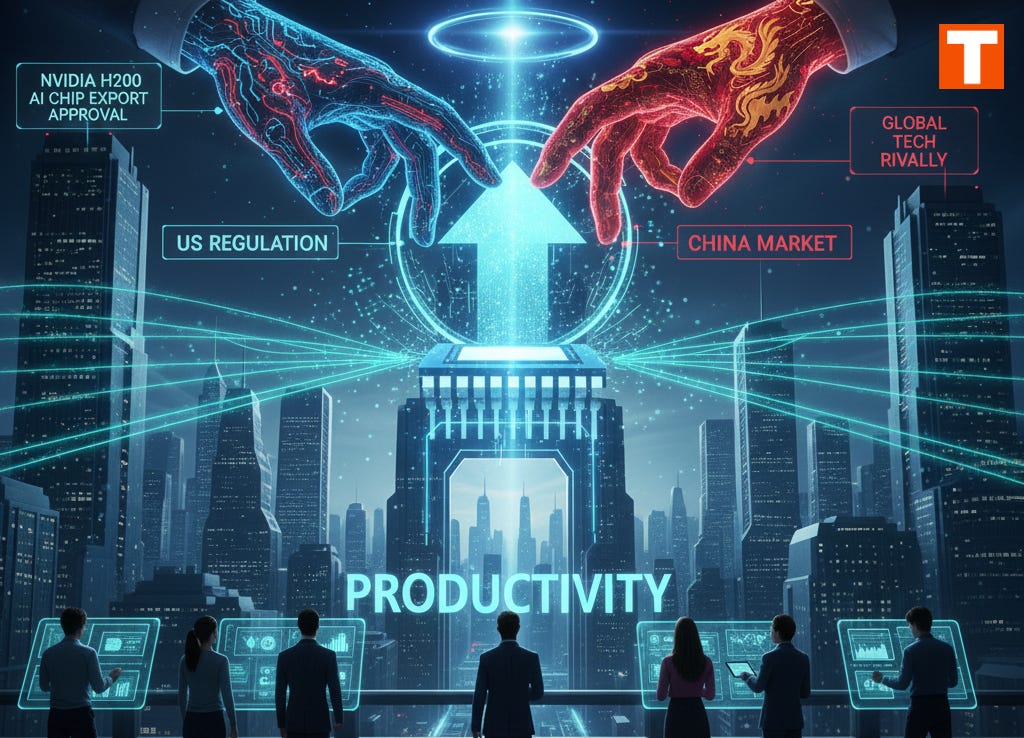
The intersection of AI and geopolitics remained a top story, revolving around the most critical commodity in the AI race: advanced chips. Reports this week confirmed that Nvidia is set to receive US approval to export its next generation H200 AI chips to China.
The H200 is an even more powerful version of the H100, and the US Department of Commerce is reportedly set to ease restrictions for the full Hopper AI GPU architecture.
My Take
This is a critical, albeit complex, development. On one hand, the easing of restrictions acknowledges the global nature of the supply chain and potentially provides a level of stability to the semiconductor market. On the other hand, it reignites the debate about technology transfer to strategic rivals.
The US appears to be walking a tightrope: maintaining a technological lead while allowing US companies to participate in the massive Chinese market. The control mechanism likely lies in the specifics of the export-approved models ensuring they are powerful but not too powerful for military or advanced research applications. This tension is unlikely to subside, as every AI breakthrough will inevitably become a talking point in the US-China trade and tech relationship.
That’s the wrap-up for last week’s key AI developments.
The speed of progress continues to be breathtaking, pushing the boundaries of what we thought possible in automation and neurotechnology.
What specific area are you most interested in for a deeper dive next week? The rise of AI agents, or the ethical implications of the new neural chips?
Let me know in the comments & have a great weekend.