

Read this first
These are my views. Most of them come from pessimism built on similar situations in the past, the 2008 financial crisis above all. I am not an investment adviser, nothing here is a forecast and where I am interpreting rather than reporting I will say so.
This is for my own reading and awareness, sharing for your reading and absolutely nothing more.
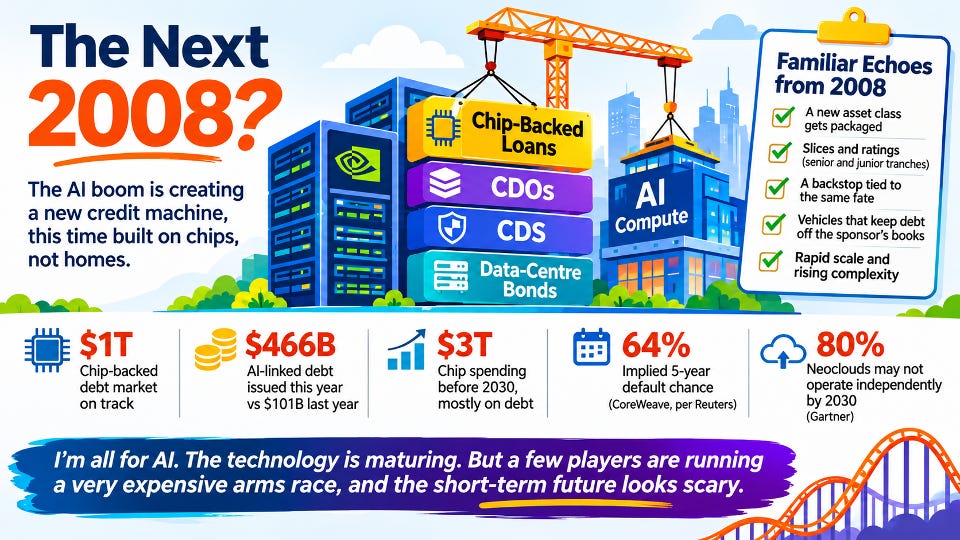
In 2023, a few Blackstone executives asked a small cloud company two questions: what is a GPU, and is AI real? The loan that followed, $2.3 billion secured on Nvidia chips, has become the template for a chip-backed debt market that Bloomberg says is on track to reach $1 trillion.
Sooner or later, do not be surprised if you see CBS (chip-backed securities), the CDOs built from them, and the CDS written on top. If none of this gives you a sense of deja vu, something is off.
Do not get me wrong. I am all for AI and thrilled by what it can do. But the technology is maturing while a few players run a very expensive arms race, and the short-term future looks scary to me.
The loan nobody understood
CoreWeave began as a cryptocurrency miner. By 2023 it had Microsoft as a major customer and needed billions to buy the Nvidia chips to serve it. Blackstone’s Tactical Opportunities group and Magnetar arranged a $2.3 billion loan secured on those chips and the Microsoft contracts, at financing costs in the double digits. If CoreWeave defaulted, lenders could take back the chips and lean on Microsoft’s payments.
Bloomberg reports that Blackstone’s executives asked CoreWeave’s leaders “What is a GPU?” and “Is AI real?”, which it calls entirely logical questions. CoreWeave’s co-founder Brannin McBee has called it “the most challenging due diligence of my career.”
There was nothing reckless about the first deal. A careful lender, an asset it could repossess, a contract with one of the strongest customers on earth. New asset classes usually start this way. The question is what happens after the template is copied a few hundred times.
How the machine got built
It was copied, and it got cheaper each time.
Circa 2024
a $7.5 billion CoreWeave loan from Blackstone and Magnetar. Lambda raises roughly $500 million in what is described as a first GPU-backed asset-backed security.
March 2026
CoreWeave closes an $8.5 billion facility backed by Meta contracts. Part of it carries 5.9%, against mid-teens rates in 2023, and it is called the first investment-grade-rated GPU-backed financing.
June 2026
Apollo and Blackstone announce a $35 billion financing for Anthropic’s chips, with Broadcom helping protect lenders. One report says the top senior tranche priced at 5.75% and a $4.5 billion junior tranche at 8.5%.August 2026
Nvidia works with six Wall Street firms on a plan to mobilise more than $500 billion for AI infrastructure.23 October 2026
Bloomberg reports Apollo and Goldman leading a $40 billion financing for SpaceX.
Morgan Stanley estimates AI-linked companies have issued about $466 billion of debt so far this year, against $101 billion a year earlier. JPMorgan analysts say chip spending before 2030 could pass $3 trillion, mostly reliant on debt.
Blackstone’s John Watson compares this to early car financing, when lenders doubted people would buy cars: “We have a similar vision for compute.” That is a fair argument. It is also the argument every new asset class makes just before it becomes a big one.
Three weeks in October
The first borrower is now the first stress point. On 13 October CoreWeave’s 2032 bonds touched a 15% yield. On the 14th its shares fell 15.46% to $65.78, hotter US inflation lifted rate expectations, and Gartner forecast that more than 80% of neoclouds would stop operating independently by 2030. By the 15th the cost of insuring CoreWeave’s debt hit a record 1,194.5 basis points.
Reuters says a spread near 1,000 basis points implies roughly a 64% chance of default over five years. Treat that as a price, not a forecast. Still, CoreWeave owes between $35 billion and $52 billion depending on whether leases count, lost $626 million last quarter, and paid $640 million in net interest, up from $267 million a year earlier. Its backlog of $104.2 billion is a company claim, and its CEO says that is enough to cover the debt.
The broader gauge is moving too. Morgan Stanley says credit default swaps on seven AI-linked issuers traded over $9 billion a week in September, up from under $2 billion in July.
Why it feels kinda familiar?
I see five echoes of 2008. These are about structure and incentives. No chip-backed loan loss has been reported.
A new asset class gets packaged.
Mortgages became mortgage-backed securities. Chips are becoming chip-backed loans and data-centre bonds. A Substack writer already calls them collateralized chip obligations, while saying he does not predict a 2008-style crisis.
Slices and ratings.
Risk is cut into senior and junior tranches, and the senior ones earn investment-grade ratings. In the reported Anthropic deal, the ratings lean on a chipmaker’s backstop.
A backstop tied to the same fate.
In 2008, AIG sold protection on mortgage securities. By 12 September 2008 it had posted about $20 billion in collateral, owed $8.6 billion more three days later, and the eventual bailout reached $182.3 billion. Today Nvidia and Broadcom reportedly stand behind chip loans, and Nvidia also owns a stake in the borrower and agreed to buy its unsold capacity. A backstop is worth least exactly when it is needed most.
Vehicles that keep debt off the sponsor’s books
Meta reportedly pays about $6.5 billion extra to keep $27 billion of data-centre debt off its balance sheet. Moody’s notes such structures can understate what hyperscalers owe. It is legal and disclosed. It is also the kind of complexity Russ Mould of AJ Bell says “will bring back bad memories for experienced investors.”
Insurance on the bet, and money from outside the banks.
Credit default swaps on AI names are now heavily traded. And CoreWeave’s co-founder told the Financial Times the company wants to tap insurers’ “unlimited” capital, which needs investment-grade ratings on chip-backed loans.
Where do CDOs come in?
I have not seen chip-backed loans pooled and repackaged into new securities. The pieces are on the table: the loans, the tranches, the swaps. My bet is that someone will eventually try to assemble the rest. That is my own bet, and nobody has reported it.
Where the comparison breaks?
The differences matter, and I would be dishonest to skip them.
Few borrowers, not millions
2008 spread risk across a huge number of households. This boom concentrates it in a handful of well-known names: chipmakers, cloud giants and new cloud providers. It’s noted that only seven institutions provide credit support for GPUs. So, concentration is its own kind of risk.
The collateral earns money
A chip rents out for cash. Loans are repaid over five to six years, roughly the life the chips are expected to have, so the structure is built around depreciation instead of assuming prices rise.
Strong customers
Microsoft, Meta and Anthropic are the targeted renters. Big Tech is forecast to spend over $600 billion on capex this year against about $700 billion of operating cash flow.
Secured loans still trade near face value, even as CoreWeave’s unsecured bonds yield around 15%.
Banks’ exposure is unreported
Much of this sits in private credit and insurers. How it reaches banks and households is not yet visible.
The parts of the 2008 stack I cannot find here are re-securitisation and large synthetic bets on chip pools. If they appear, my worry grows.
The best case against us.
A good skeptic would say the following, and some of it is persuasive.
Reuters frames the stress as a question about funding costs, not weak AI demand, and says CoreWeave’s failure would not by itself trigger a wider financial crisis.
A Bloomberg opinion piece on 20 October argued investors overreacted and that fallout may stay with a handful of similar companies.
Demand for older chips has held up. A100 capacity is reported nearly fully booked, and CoreWeave says it renewed an expiring three-year-old H100 contract within 5% of the earlier price. That second point is the company’s own claim.
Deutsche Bank’s Brad Zelnick called the sell-off a buying opportunity. Bernstein’s Madison Rezaei stayed at Underperform. Analysts are split.
Prediction markets are calm: Polymarket traders put a qualifying AI downturn at 9% by the end of 2026, though the contract needs three specified distress events within 90 days.
I could be wrong in the best possible way. If chips keep earning their keep, the loans get repaid and this becomes a case study in a successful new asset class.
What are we watching?
Six things will tell me whether this is a scare or a pattern.
Used-chip prices and rental rates. A sharp, sustained drop in what an H100 or A100 earns or resells for is the first crack. A three-year-old H100 system recently resold at about 45% of a new one.
Whether any chipmaker backstop is ever called, and how large the guarantees really are.
CoreWeave’s bonds and swaps. Spreads staying above 1,000 basis points would say the market has made up its mind.
Who buys the senior tranches. Nuveen’s Laura Parrott is holding off on large investment-grade chip deals until the structures have faced a real disruption.
Insurer and private-credit disclosures. I want to see how much neocloud paper sits in portfolios that are meant to be boring.
Rates. Heavy debt behaves one way at 6% and another at 9%.
I am for AI, and I expect it to be bigger than most people think. That is exactly why I want its financing to be dull and well understood. A technology can be real and the way it was paid for can still hurt. Railways were real.
If you read the 2008 inquiry reports, the warning signs were visible well before the end, and most were dismissed because the story was too good. I would rather be early and wrong in public than late and right in private.