

Smarter people. Better insights. Deeper analysis.
The assumption was simple, if we could just think better, outcomes would follow.
But that assumption has always been wrong.
Intelligence is an ingredient, an important one but it has never been the source of value by itself.
Businesses don’t get paid for insight.
They get paid for execution.
And this is not new wisdom, it’s old; almost boring wisdom.
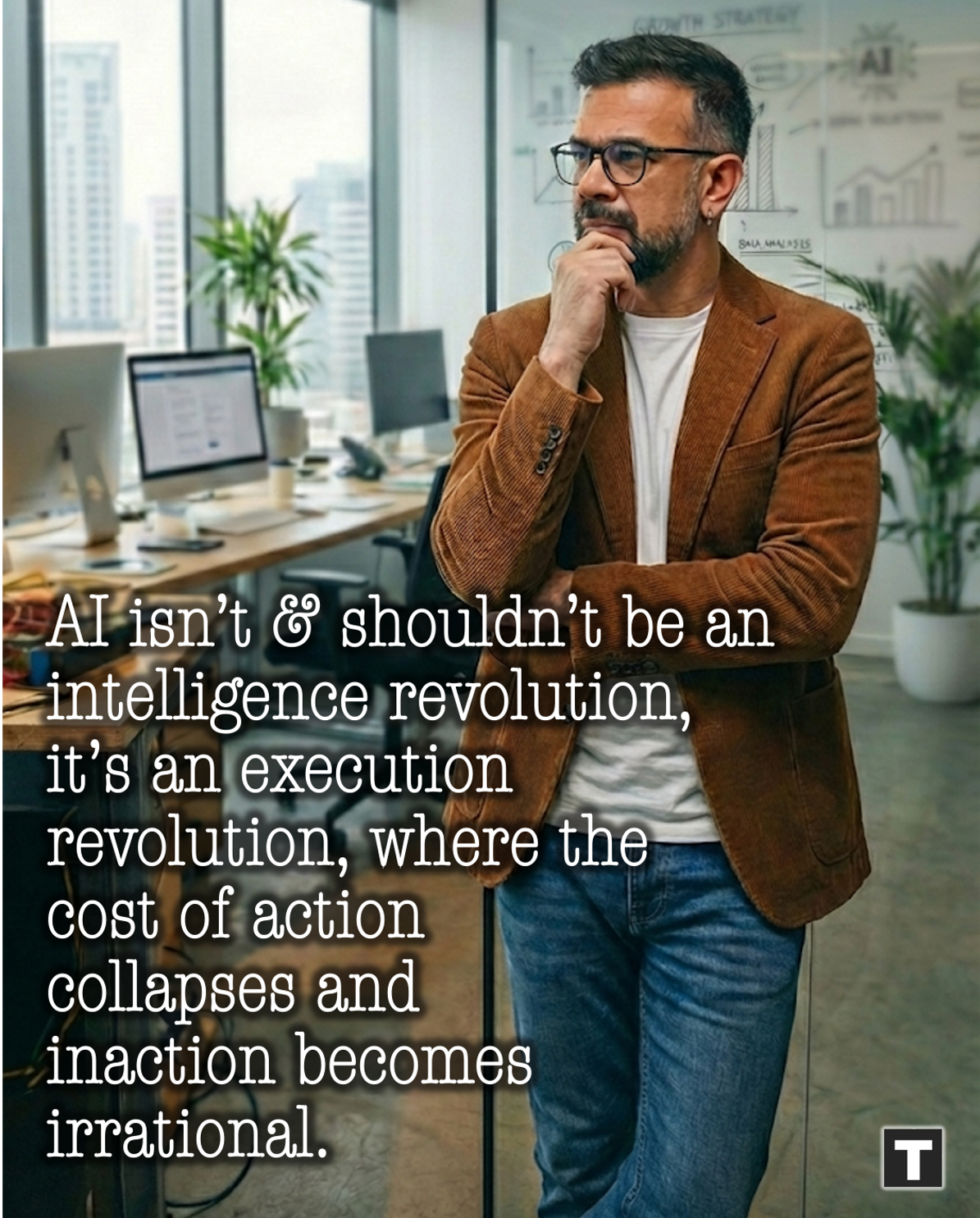
What is new is that we are now living through a moment where the cost of execution itself is collapsing.
That changes everything
AI Feels Different? Yes. This Time, It Is.
Until recently, most AI conversations were stuck in the realm of thinking
Better predictions
Smarter recommendations
Faster analysis
More elegant reasoning
Useful? Yes.
Transformative? Not really.
They made decision-makers feel smarter, but left the hard part untouched: doing the work.
What’s happening now in the realm of Agentic AI is not an incremental improvement in intelligence.
It’s an existential shift in execution.
When the cost of doing drops dramatically across multiple domains—writing, coding, research, design, operations, automation stops being a future roadmap item.
It becomes the default.
Not because leaders suddenly become bold or visionary.
But because inaction becomes irrational.
At a certain point, choosing not to automate is no longer conservative. It’s negligent
Execution Is No Longer the Scarce Resource
Historically, execution was expensive
Hiring took time
Coordination took effort
Shipping took months
Learning loops took quarters
That friction acted as a natural brake. Even with great ideas, organizations moved slowly because they had to.
AI changes that equation.
When execution becomes cheap, fast, and repeatable, the constraint shifts:
Not Can we build this?
But Why aren’t we already doing this?
This is why the current moment feels existential. Entire categories of work that once required teams, budgets, and long timelines can now be executed continuously, automatically, and at scale.
And once execution is cheap, waiting is the most expensive option.
The Unlock? Closed Loops, Not Smarter Models
The biggest mistake companies make right now is obsessing over intelligence
Which model is smarter?
Which benchmark is higher?
Which AI “understands” better?
That’s missing the point.
The real unlock is not intelligence, it’s closed loops.
Systems that don’t just think, but act.
Decide → Act → Ship → Learn → Repeat
This is where value is created.
A system that makes slightly worse decisions but executes continuously will outperform a system that makes perfect decisions but never ships.
Closed loops compound. Insights alone do not.
Governance Matters More Than Ever
Execution at scale is powerful and dangerous, without constraints.
As the cost of action approaches zero, the blast radius of mistakes grows. That’s why governance is not optional overhead; it’s the foundation.
Rock-solid governance means
Clear boundaries on what systems can and cannot do
Human checkpoints where stakes are high
Auditability and traceability of actions
Explicit ownership of outcomes
The goal is not to slow execution.
It’s to make fast execution safe.
The organizations that win won’t be the ones that automate recklessly. They’ll be the ones that automate responsibly, with closed loops anchored in accountability.
AI Doesn’t Win Because It’s Intelligent
This is the uncomfortable truth: AI doesn’t win because it’s smarter than humans.
It wins because it executes relentlessly.
It doesn’t get tired.
It doesn’t wait for alignment meetings.
It doesn’t defer decisions out of fear.
It acts, learns, adjusts, and acts again, at a speed and scale that human systems were never designed to match.
That’s the shift.
Not from human to machine intelligence.
But from thinking-first organizations to execution-first systems.
Question We Must Answer
The defining question is no longer, How can AI help us think better? But
What decisions are we still making manually that could already be part of a closed execution loop?
Because in a world where execution is cheap, slow organizations don’t lose to smarter ones.
They lose to faster ones and the fastest systems aren’t the ones with the best ideas.
They’re the ones that act.