

I met someone a couple of months ago who had just returned from the US, unable to stop talking about The Sphere. You’ve likely seen the clips, a technological marvel, a $2.3 billion venue in Vegas that redefines immersive entertainment.
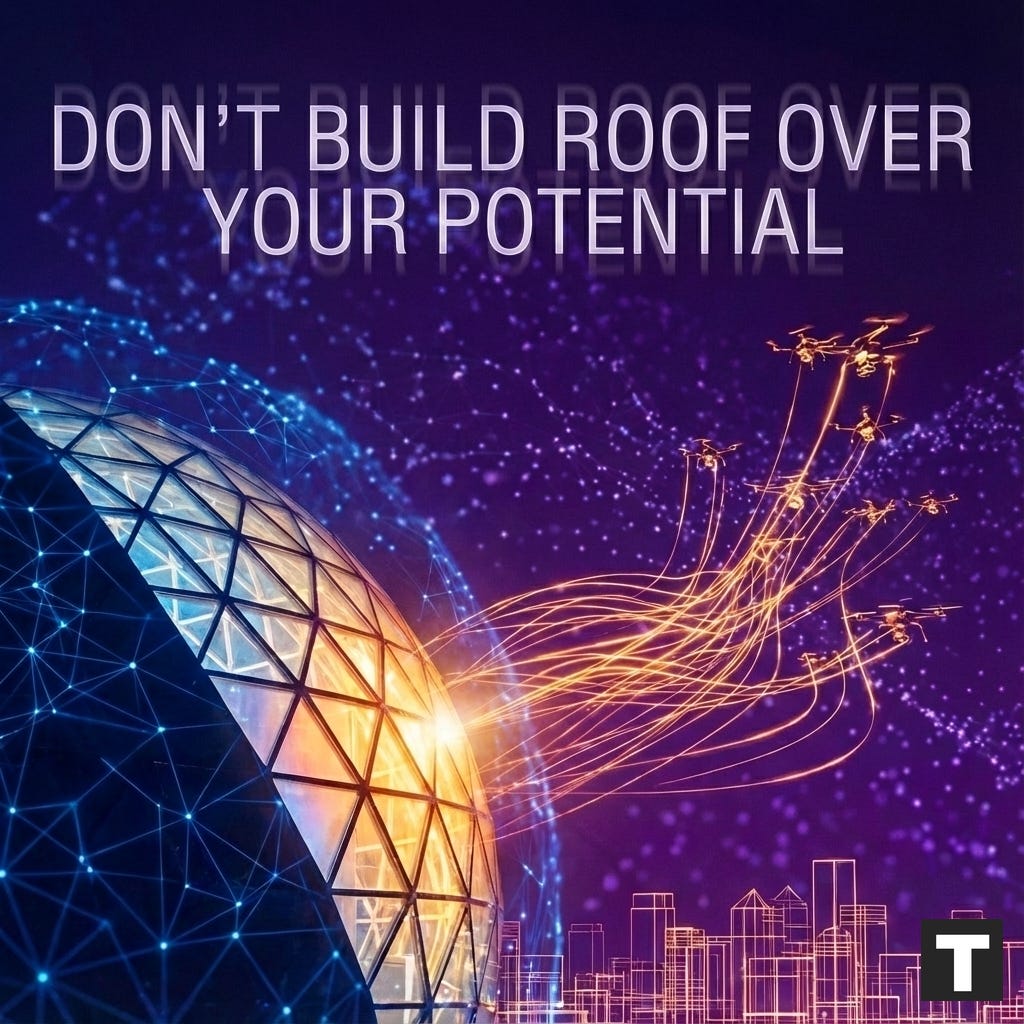
But while they were mesmerised by the screen resolution and the whole audience experience, I was doing the math in my head.
As a feat of engineering, it is undeniable. But as a business model? It is capital-intensive, location-dependent, and rigid. It is a monument.
It’s akin to physical buttons that Steve Jobs so desperately wanted to completely remove when he launched the iPhone
Now, contrast that with what we just witnessed in China to welcome 2026.
An AI-powered firework and drone spectacle where the entire town turned into a stage.
It wasn’t confined to a building
It didn’t require a $100 ticket to see.
And, it was a highly replicable, software-defined utility that turned the existing environment into a canvas.
The Sphere can accommodate 18,000 people, a small village. The AI-orchestrated show in China accommodated a whole city.
Let that sink in.
This isn’t just a comparison of entertainment venues. It is the perfect metaphor for the two ways you can approach the AI wave. One is a rigid, expensive trap. The other is a scalable, infinite opportunity, powered by AI.
The Tiny-Sphere Business Trap
The Sphere represents the old way of thinking about tech: High CapEx, Low Agility.
In the corporate world, Spheres are those massive, monolithic projects.
They are the proprietary models built on-premise that cost millions to train, take years to deploy, and become obsolete the moment a more efficient open-source model drops.
Take a pause and think: How many tiny Spheres are hiding in your business?
The Sphere Project
The chatbot required a 6-month custom build and only answers 20% of queries correctly.The Sphere Team
The siloed data science unit that builds brilliant models that never make it into production because they don’t fit the legacy infrastructure.
Each of these is a potential threat. They look impressive on a slide deck (tech marvels), but they offer terrible RoI and cannot scale when the market shifts.
The Sky Strategy
The China event wasn’t about the hardware (the drones or fireworks); it was about the Orchestrator, an AI orchestrator.
The value wasn’t in the individual drone, but in the AI that coordinated some 11,000 of ‘em simultaneously to paint a dragon across the sky.
This is the software-defined approach.
Scalability
You don’t build a bigger building; you just add more nodes to the network.Replicability
The same code that lit up Chongqing can light up Mumbai or New York tomorrow.Efficiency
It leverages existing infrastructure (the sky, the city) rather than building new ones.
Ride the Wave & Don’t Crash While Riding.
To survive the Professional Apocalypse, the point where rigid skills and rigid businesses hit the wall of AI speed, we need to shift our focus.
1. At the Enterprise Level
We must evolve our thinking from Monument Builder to Ecosystem Orchestrator
Stop building Spheres. Stop trying to own the hardware or build the “perfect” static model.
Focus on Interoperability
Your AI shouldn’t be a walled garden. It needs to be the “firework show” that works across different clouds, data lakes, and user interfaces.Value Orchestration over Creation
The highest RoI won’t come from building the LLM, but from orchestrating agents to execute complex workflows.Fluidity is the Asset
If your AI strategy requires a 5-year depreciation schedule to make sense, it’s already dead.
2. At the Individual Level
Don’t hide in the Shadows!
As professionals, we often build tiny spheres around our careers, niche skills that are hard to learn and expensive to maintain. We think this protects us.
It doesn’t.
If your value is tied to operating a single, complex tool (a Sphere), you are vulnerable. When the tool changes, or when AI automates the tool, your value drops to zero.
Be the Orchestrator
Don’t just be the Excel guy or the Python coder. Be the person who understands how to string together AI agents to solve a business problem.Audit Your Shadow
Look at your daily tasks. Which ones are Spheres (manual, expensive, hard to scale)? If you don’t deal with them, automating them or upskilling out of them, you are essentially waiting for the apocalypse.Think City-Scale
Ask yourself, if I had to do this task 10,000 times a day, how would I design it? That is the mindset that wins in 2026.
Bottom Line
The Sphere is a beautiful place to visit, but you wouldn’t want to be the one paying the electric bill.
The future belongs to the orchestrators, those who can turn the whole world into a stage. The idea is not to succumb to the fear of this shift, but to be prepared.
Don’t build a roof over your potential. Look at the sky.