

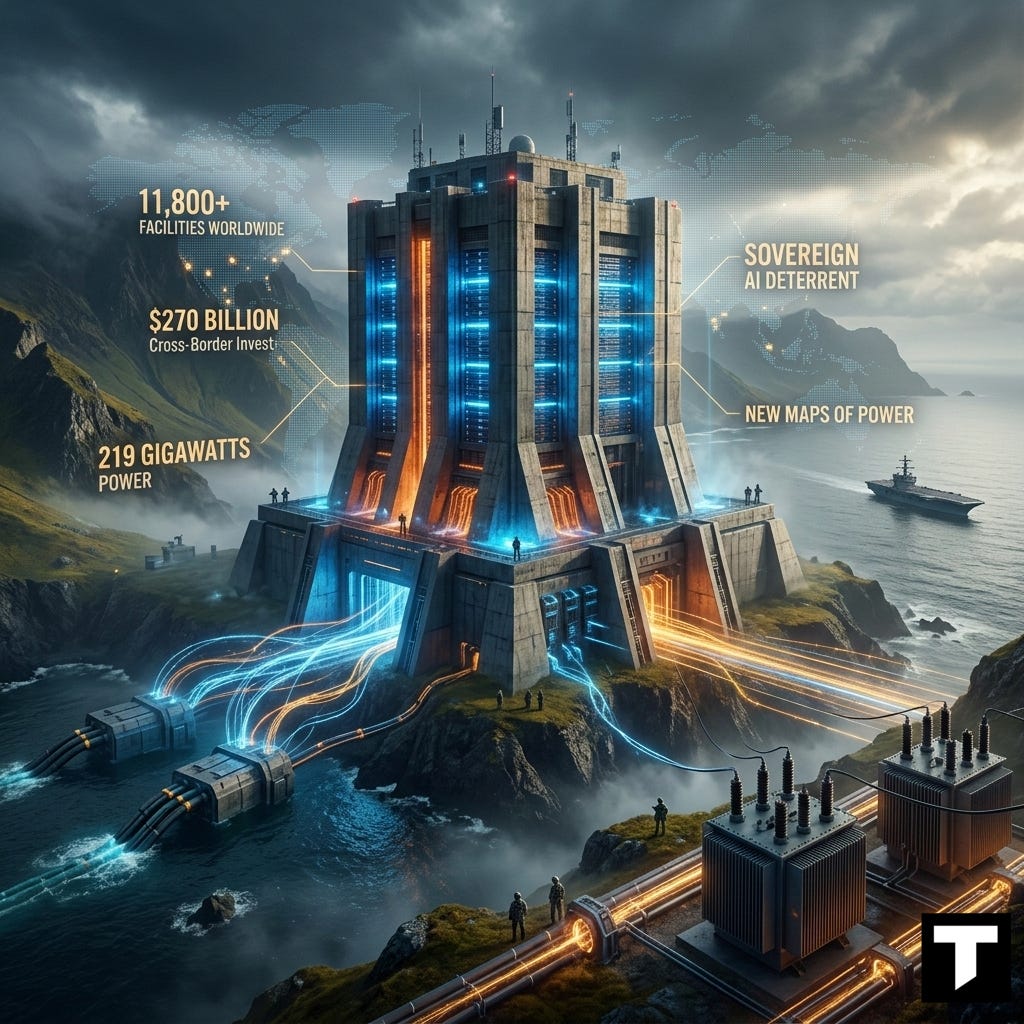
Consider these numbers: 11,800+ operational facilities worldwide.
$270 billion in cross-border investments in a single year. 219 Gigawatts of projected power demand.
For centuries, the maps of global power were drawn with ink and blood over natural resources, warm-water ports, and arable land. Today, those maps are being redrawn over windowless, climate-controlled warehouses. Data centers are no longer just the passive plumbing of the internet. They are the most vital strategic strongholds of the 21st century.
If we want to understand the future of global security, we need to fundamentally rethink what constitutes a military base.
Here is why the global power struggle has quietly relocated to the cloud.
Compute as the New Deterrent
In the 20th century, nuclear stockpiles acted as the ultimate geopolitical deterrent. Today, that deterrent is shifting toward Sovereign AI, which is artificial intelligence developed, trained, and hosted entirely within a single jurisdiction.
You cannot run predictive battlefield analytics, defend against automated cyber warfare, or develop autonomous defensive systems without hyperscale computing. The capacity to process exabytes of data is no longer a commercial advantage; it is a matter of national survival. A nation without its own compute infrastructure is entirely reliant on the goodwill of those who host its data, rendering it strategically defenseless
Choke Points & Invisible Blockades
Historical blockades involved warships cutting off trade routes. Today’s blockades are economic and technological.
A modern data center relies on highly advanced semiconductors, specialized cooling hardware, and the sprawling network of underwater fiber-optic cables that connect them to the world.
When export controls are placed on advanced microchips, it is not merely a trade dispute. It is a modern siege tactic designed to starve a rival’s infrastructure of processing power. Control over the supply chain of a silicon wafer is now just as critical as control over a major physical shipping strait.
The Weaponization of Watts
The scale of energy required by these facilities is staggering. By 2030, global data centers are projected to consume more electricity than many developed nations.
This creates a terrifying new vulnerability. To maintain technological sovereignty, a state must secure uninterrupted, massive supplies of energy and water for cooling. Consequently, an adversary no longer needs to target a military installation to cripple a nation. Disrupting the regional power grid or water supply that feeds a primary data center cluster can blind intelligence networks and freeze financial systems in seconds. Energy policy is now inextricably linked to digital defense.
The Vulnerability of Concentration
We are currently building massive, centralized points of failure. In any future kinetic or cyber conflict, severing a region’s connection to the cloud will be a primary, day one objective.
Why risk human lives and expensive traditional weaponry when a coordinated cyberattack, or a targeted strike on a massive server farm, can simultaneously disable an adversary’s logistics, banking, and communications? The concentration of digital assets into massive, centralized warehouses makes them high-value targets that are increasingly difficult to defend.
A Paradigm Shift in Power
We need to start educating our policymakers, strategists, and citizens about this new reality. Geopolitical dominance is no longer measured purely by the number of aircraft carriers in a fleet. It is measured by
megawatts, compute capacity, and network latency.
The physical infrastructure of the internet is the new contested territory. The nations and alliances that build, secure, and power these facilities will dictate the technological and economic realities for the rest of the world.
The cold war of our era is already here, and the servers are running hot.