

You weren’t learning a skill.
You were compensating for a product defect.
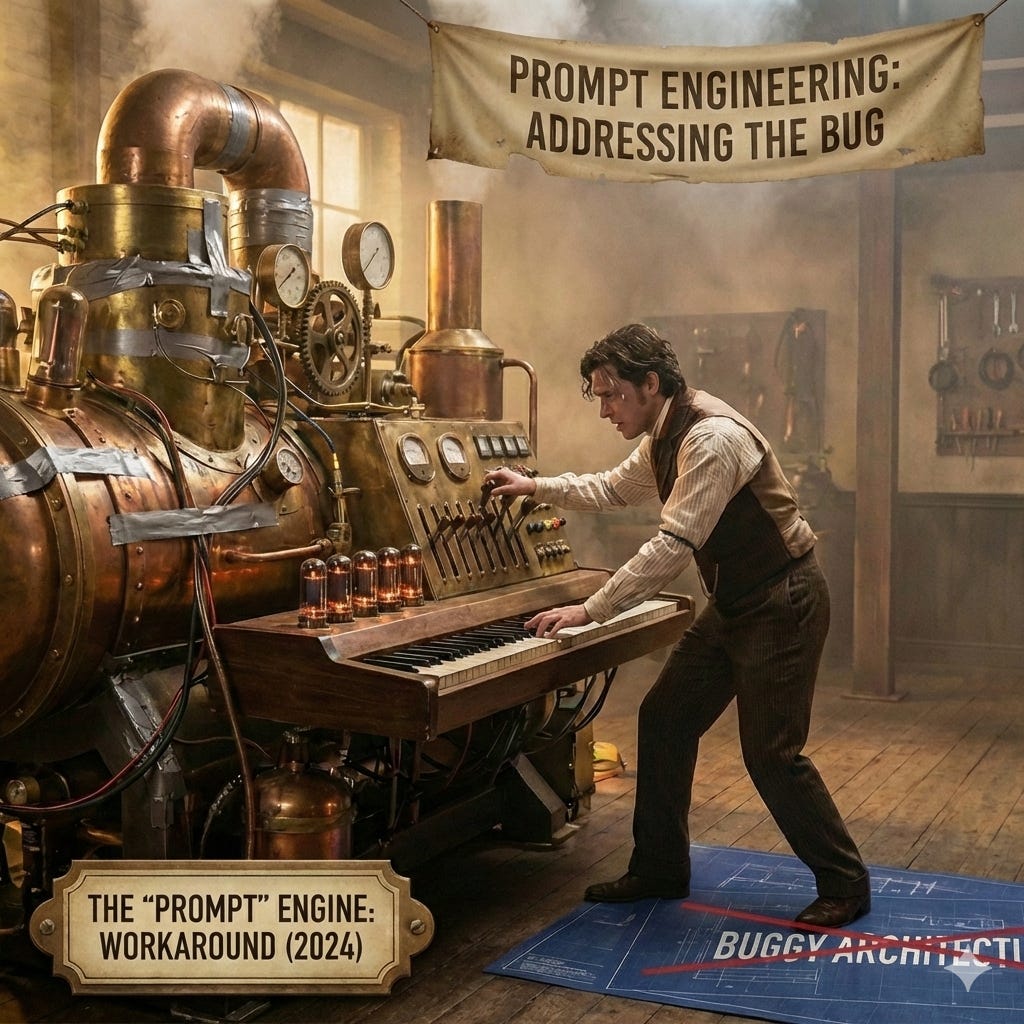
In late 2023 and throughout 2024, the tech world convinced itself that “Prompt Engineering” was the sexiest job of the 21st century. We saw salaries hitting $300k for people who could essentially whisper nicely to a chatbot. We built entire curricula around “Chain-of-Thought” reasoning and “few-shot” examples.
But as we settle into 2026, the reality is becoming impossible to ignore. We are witnessing the rapid extinction of the “Prompt Engineer.”
Just like the “Switchboard Operator” or the “Human Computer” (who manually calculated ballistics) before it, this role isn’t disappearing because the work is gone. It’s disappearing because the interface is finally maturing.
The “Whisperer” was never a feature of the AI revolution. It was a bug.
The “Manual Transmission” Era is Over
For the last two years, we have been treating AI models like a finicky manual transmission car from the 1950s.
If you didn’t shift the gears (prompts) at the exact right RPM, the engine would stall (hallucinate) or the car would veer off a cliff (refuse to answer). We convinced ourselves that knowing how to shift those gears—knowing exactly which magic words to type—was a career.
But look at the shift we discussed last week regarding the rise of Agentic AI.
When you hire a senior human software engineer, you don’t write them a 500-line “prompt” detailing every synapse they need to fire to write a Python script. You don’t say, “Act as a developer. Take a breath. Think step by step. Don’t forget the semicolon.”
You give them a goal.
The Old Way (Prompt Engineering): “Act as a senior python developer. Think step by step. Don’t hallucinate. Careful with the syntax. Here is the library documentation. Write a function that...”
The New Way (Agentic Delegation): “Refactor this codebase to reduce latency by 20%.”
The moment the model can reason—and with the imminent arrival of DeepSeek V4 and the rumored Claude Sonnet 5, that reasoning capability is becoming commoditized—the need for “whispering” evaporates. The model doesn’t need to be tricked into being smart. It just is.
The Data: Why “Architecture” Beats “Whispering”
The industry is moving decisively from a Semantic Layer problem (how do I ask?) to an Application Layer problem (how do I structure?).
As I’ve written before at Technoclast, the real value isn’t in the foundation model anymore. That is just a commodity layer of intelligence, electricity waiting for a circuit. The value is in the architecture you build on top of it.
If you want irrefutable proof that the “Prompting” era is dead, look at the hardware and model architecture shifts from just the last week:
1. The Efficiency of LiquidAI (LFM 2.5) LiquidAI released LFM 2.5 last week. This is a 1.2 billion parameter model. In the old world, a model this small would be “dumb” and require massive prompt engineering to output anything coherent. Yet, LFM 2.5 is outperforming models three to four times its size (like Qwen 3B).
This proves that novel architectures (Liquid Neural Networks) are solving the “intelligence” gap better than clever prompts ever could. We don’t need to coax the model; we just need better math.
2. The Sparsity of Arcee Trinity The release of Arcee Trinity demonstrates the power of “Scale-In” architecture. It boasts 400 billion total parameters, but only activates 13 billion during inference.
This is a structural breakthrough, not a linguistic one. It allows us to run high-level reasoning agents at a fraction of the cost.
We are moving away from massive, monolithic models that need “guidance” and toward specialized, efficient models that need “deployment.”
The New Role: The “Agent Architect”
So, if the Prompt Engineer is dead, who replaces them?
We are leaving the era of the “AI Poet” and entering the era of the “AI General Contractor.” We call this role the Agent Architect.
The distinction is vital:
The Prompt Engineer tries to get one model to do one thing perfectly by asking nicely. They are obsessed with syntax, tone, and “jailbreaking.”
The Agent Architect designs a system where specialized, smaller agents hand off tasks to one another. They are obsessed with data flow, latency, and success metrics.
Imagine a workflow for a financial analysis bot.
Agent A (The Researcher): Uses a tool to scrape the web (perhaps running on a cheap, fast model like Llama-3-8b).
Agent B (The Analyst): Takes that raw data and finds patterns (running on a high-reasoning model like DeepSeek V4).
Agent C (The Coder): Visualizes the data in Python (running on a coding-specific model).
You don’t “prompt” this system. You orchestrate it. You define the guardrails, the tools, and the evaluation loops. You stop being a writer and start being an engineer again.
My Takeaway
If your entire AI strategy in 2026 relies on a specific employee’s ability to write a “magic spell” prompt to get ChatGPT to do its job, you have built a fragile system. You are betting on the “manual transmission” remaining the standard in a world of self-driving cars.
The “Gold Rush” for prompt packs, cheat sheets, and “100 Best Prompts for Marketing” is over.
The future belongs to those who understand data flows, latency, and agentic orchestration.
Stop trying to whisper to the horse. It’s time to learn how to command the cavalry.