

For the last two decades, enterprise technology has followed a predictable arc.
First, software replaced paper. Then, SaaS replaced installed software.
Next, APIs replaced human handoffs.
Now, something more consequential is underway.
Not Software-as-a-Service.
But Service-as-a-Software.
This is not a semantic distinction, but a structural one.
What Changed?
Traditional enterprise software has always been instrumental.
It enabled humans to perform work faster, cheaper, and at scale.
Even advanced SaaS platforms, CRM systems, ERP stacks, analytics tools stopped short of owning outcomes.
Responsibility remained human & Agentic AI changes that boundary.
An agent does not merely
Recommend actions
Surface insights
Trigger alerts
It is expected to (if not, It can)
Interpret objectives
Sequence tasks
Coordinate across systems
Execute decisions
Monitor outcomes
Correct itself over time
In other words, it behaves less like a tool and more like a junior service provider.
Once that threshold is crossed, the economic logic of software fundamentally changes
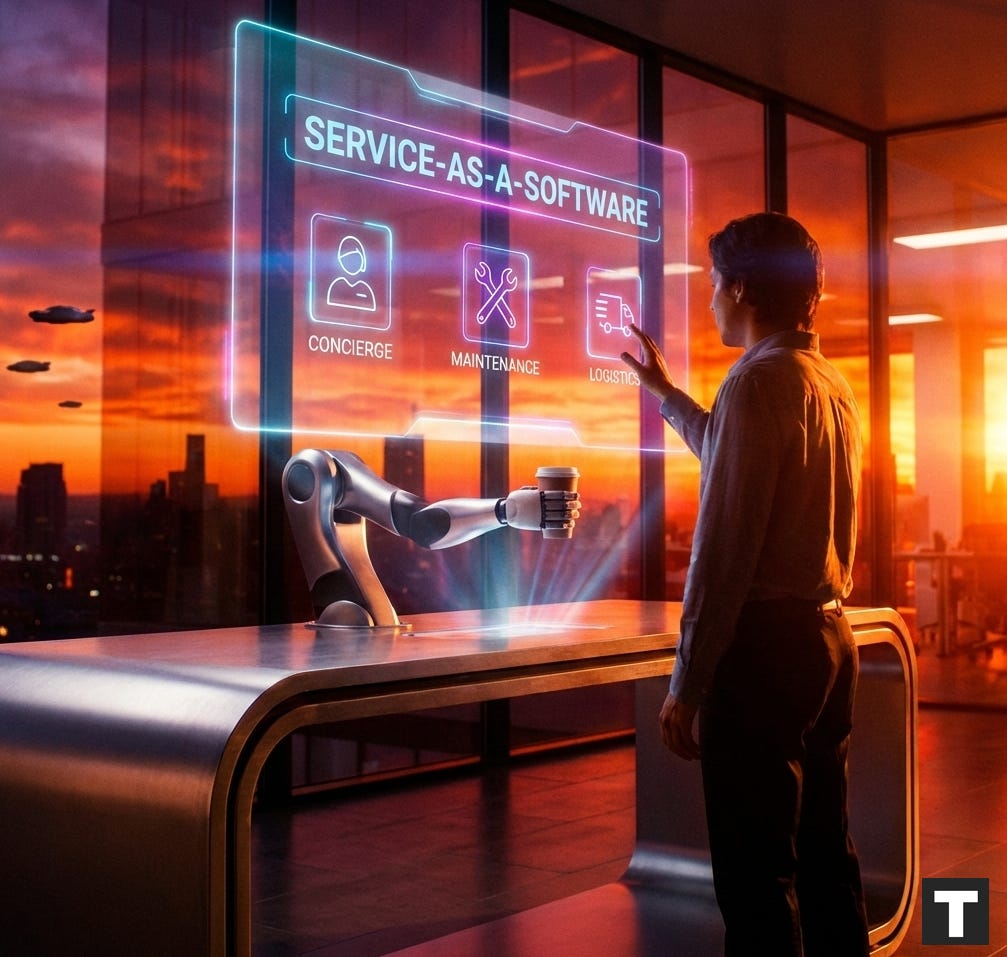
From Using-Software To Hiring-Software
A large regional bank in Asia (name withheld) deployed an AI agent to handle AML alert triage.
Initially, the agent
Read transaction alerts
Clustered related activities
Prioritised cases for human analysts
Within six months, the scope expanded
The agent auto-closed low-risk alerts
Drafted regulatory narratives
Escalated only edge cases
By year one, over 65% of alerts never touched a human analyst.
Here is the critical insight.
The bank no longer thought of this as AML software.
Internally, it was referred to as:
Our Level-1 AML operations.
Budget conversations shifted accordingly i.e., from IT procurement to operational cost replacement.
This is the moment Service-as-a-Software is born.
SaaS Economics Break Under Agentic AI
SaaS pricing models were built for tools
Per-seat
Per-license
Per-usage
Per-API call
But agents do not scale like tools, they scale like teams.
An agent that
Processes claims
Reconciles invoices
Onboards merchants
Manages compliance filings
Is not competing with another SaaS vendor.
It is competing with BPOs, shared service centers, and managed services firms.
That forces a pricing reset:
Cost per resolved claim
Cost per compliant filing
Cost per onboarded customer
SLA-based outcome pricing
This is why Service-as-a-Software is inevitable, not aspirational.
SaaS → Service Collapse Is Already Visible
If you look closely, the signals are already there. (Do chime in Comments, if you see more such signals)
Salesforce is embedding autonomous agents that act on pipeline data, not just report on it.
UiPath is moving from scripted RPA to goal-driven automation.
OpenAI is no longer selling models, but capabilities—reasoning, planning, tool use.
What looks like feature expansion is, in reality, role replacement.
Service-as-a-Software, Really?
Service-as-a-Software refers to software systems that
Are agentic, not reactive
Own defined operational outcomes
Replace or materially shrink human service layers
Are priced against services, not licenses
Think less:
“Here is a platform to manage procurement.”
And more:
“Here is procurement—fully handled.”
Where This Will Emerge First (Why?)
Not all services will collapse into software at the same pace.
1. Highly Structured Services
Compliance monitoring
Financial reconciliations
Reporting & filings
These are rule-heavy, auditable, and outcome-defined.
2. High-Volume, Low-Variance Operations
Customer support Tier-1
Claims processing
Loan origination checks
3. Digitally Native Public Infrastructure
Governments experimenting with digital public goods will move fastest—because scale and cost pressures are existential.
In these environments, Service-as-a-Software is not a nice-to-have. It is the only viable scaling model.
Why This Is Bigger Than Automation
Automation optimized tasks.
Agentic systems optimize responsibility.
Once responsibility shifts:
Risk models change
Compliance frameworks evolve
Procurement reclassifies spend
Leadership accountability redraws
This is why the implications are not just technical—they are institutional.
The Second-Order Effect
As services collapse into software:
Enterprises will rebundle around judgment, governance, and exceptions
Headcount pyramids invert
Vendor ecosystems consolidate dramatically
The winners will not be those with the best models, but those who
Clearly define outcomes
Absorb operational risk
Integrate deeply into institutional workflows
In short, the winners will look less like software companies and more like digital service providers that happen to ship code.
Quiet but, Inevitable Transition
Every major technology shift begins as a tooling story and ends as a business model rewrite.
Agentic AI is already past the tooling phase.
The question is no longer:
“Can software do this?” But, “Why are we still running this as a service?”
Service-as-a-Software is not coming, it’ s already here - Just not yet labeled.
And as with all structural shifts, by the time it is obvious, it will already be too late to react.