

Is the Lakehouse the unified future we were promised, or just another buzzword?
If you work with data today, you are likely feeling overwhelmed. The landscape is messy. We are generating petabytes of information, structured logs, unstructured text, images, real-time IoT streams, and the pressure to turn that raw noise into actionable signal (and increasingly, AI models) has never been higher.
For the past decade, data teams have been caught in a tug-of-war between two dominant architectural patterns: the rigid reliability of the Data Warehouse and the chaotic flexibility of the Data Lake.
Neither is perfect. Both create silos.
Enter the Data Lakehouse.
It is the hottest term in data engineering right now, promising to unify our fractured infrastructure. But what is it really? Why does it matter? And most importantly, what is the ground-level reality of adopting it?
Today, we are cutting through the hype to explore the architecture designed to clean up the mess

How We Got Here
The tale of Two Silos.
To understand the Lakehouse, we first need to understand the problem it solves. Historically, organizations have maintained two separate, disconnected systems for managing data.
1. The Data Warehouse (The Library)
What it is?
A highly structured database optimized for fast queries and business intelligence (BI) reporting. Think of it like a meticulously organized library.
The Good
Fast and reliable
Clean data with schema-on-write
Supports ACID transactions and strong data integrity
The Bad
Expensive and rigid
Poor fit for unstructured data like video or text
Struggles to scale for modern machine learning workloads
2. The Data Lake (The Dumping Ground)
What it is
A vast repository built on cheap cloud object storage, such as AWS S3 or Azure Blob, that holds raw data in its native format.
The Good
Cheap and infinitely scalable
Extremely flexible with schema-on-read
Ideal for exploratory analysis and data science
The Bad
Often turns into a “data swamp”
Weak governance and data quality controls
Poor performance for reliable BI reporting
Core Problem
Because BI & other Apps teams needed Warehouses and AI teams needed Lakes, companies ended up running both. This required complex and brittle ETL pipelines to constantly move and duplicate data between systems.
The result
Higher infrastructure costs
Inconsistent data definitions
Data engineering teams constantly fighting fires
Enter the Data Lakehouse
The best of both the worlds?
The Data Lakehouse is an architectural paradigm designed to eliminate this two-system dilemma.
Definition
A Data Lakehouse combines the low-cost, scalable storage of a Data Lake with the structured management, ACID transactions, and performance features of a Data Warehouse, all in a single platform.
How does it work?
It adds a smart metadata layer on top of raw cloud object storage.
Imagine a messy data lake. Now imagine laying a sophisticated, invisible grid over it that:
Catalogs where everything lives
Enforces rules on how data is written
Creates indexes that make querying fast and reliable
This metadata layer, powered by open table formats like Delta Lake, Apache Iceberg, or Apache Hudi, allows raw files in object storage to behave like structured database tables.
Why the Lakehouse Matters (The Ideal)
If implemented correctly, the Lakehouse solves several fundamental business and technical challenges.
Unification of BI and AI
This is the biggest win. Data analysts using SQL for dashboards and data scientists using Python or R for machine learning can finally work from the same data source.
No more debates about which system has the “correct” data.
ACID Transactions on Raw Data
In traditional data lakes, a failed pipeline could leave corrupted or partial data behind. Lakehouses bring warehouse-grade reliability to object storage.
You can safely:
Insert
Update
Delete
Roll back changes
Governance and Security
Instead of securing two separate platforms, the Lakehouse provides a unified control plane for:
Access policies
Auditing
Data lineage
This applies across all data types, structured and unstructured.
Cost Efficiency
By storing data in low-cost object storage and only paying for compute when queries run, organizations avoid the massive expense of keeping petabytes of data in proprietary warehouse systems.
Now, The Reality Check
The Messy Truth
If the Data Lakehouse is so powerful, why is adoption still hard? Because the reality on the ground is messier than the marketing.
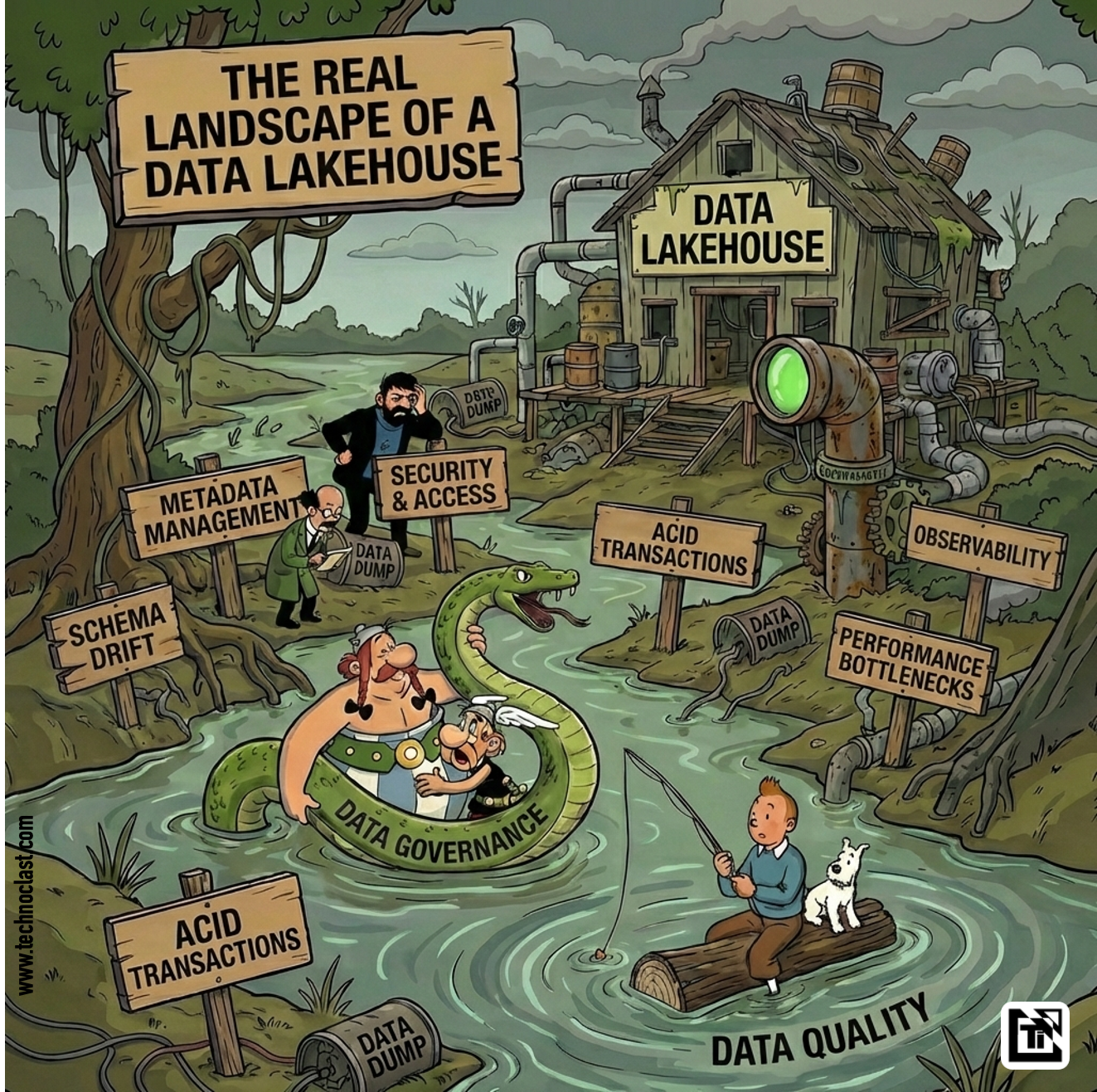
1. It Is Still Relatively Immature
Data Warehouses have benefited from over 30 years of refinement. The Lakehouse, as we know it today, is barely a decade old. Tools are evolving quickly, and best practices are still emerging.
2. The Complexity Shift
The Lakehouse removes architectural silos but shifts complexity to engineering.
Teams must manage:
Metadata layers
File compaction and sizing
Table maintenance tasks like vacuuming old files
You are not buying a finished product. You are building a platform.
3. Performance Requires Active Tuning
Warehouses are optimized for fast SQL queries out of the box. Lakehouses can match that performance, but only with proper tuning.
This includes:
Smart partitioning
File ordering strategies
Index and metadata optimization
Treat a Lakehouse like a lazy data lake, and dashboards will suffer.
4. The Open Format War
There is no single standard for the metadata layer. Teams must choose between:
Delta Lake
Apache Iceberg
Apache Hudi
Interoperability is improving, but choosing a format still feels like a high-stakes bet on the future.
The Path Forward
The Data Lakehouse is not a magic wand. It will not fix poor data quality or a broken data culture overnight.
But it is the most logical evolution of modern data architecture.
The demands of AI, real-time analytics, and scale make disconnected data silos unsustainable. While implementing a Lakehouse requires effort and a mindset shift, the destination matters.
A unified, governed, and scalable data platform is no longer optional.
The landscape is still messy, but for the first time, we have a real blueprint for cleaning it up.
What’s your experience?
Are you building a Lakehouse, sticking with a Warehouse, or drowning in a Data Swamp?
Let me know in the comments.