

It was 6°C when I stepped out of Lucknow Airport last night—the kind of cold that calls for Tunday kebabs and a hot roomali roti. The driver was hungry too & I was ready.
But instead of melt-in-the-mouth Galawatis wrapped in Roomali, we stopped for hot idlis and steaming sambar on the way to Hazratganj.
Why idli/sambar in kebab country? Because I’ve been trying to use Microsoft Copilot. So, as you’d expect, I’m completely disoriented.
Don’t get me wrong, I love Microsoft with a very small small “condition not conditions apply” footnote.
The Culinary Mismatch
Sambar is a robust, complex, and deeply functional dish.
It is a staple, reliable, essential, and built on a balance of lentils, tamarind, and native spices that have worked together for centuries. In the world of software, your OS (aka Windows), your spreadsheets (aka Excel), and your core workflows are Sambar.
They are the essential nutrition of the digital economy.
Generative AI, specifically the current iteration of “Copilot everywhere”, is Rosemary and Thyme.
These are exquisite ingredients in their own right, perfect for a roast or a focaccia. But when you forcefully dump a bushel of Rosemary into a pot of boiling Sambar, you don’t improve the Sambar.
You confuse the palate, ruin the balance, and leave the diner wishing for the simple, unadulterated original.
Late 2024 and 2025 have proven to be the moment the market spat out the spoon. Microsoft’s recent decision to slash sales targets for its agentic AI software by nearly 50% and the rising user backlash against “forced” integration signals a critical lesson…
Utility cannot be synthesized by force.
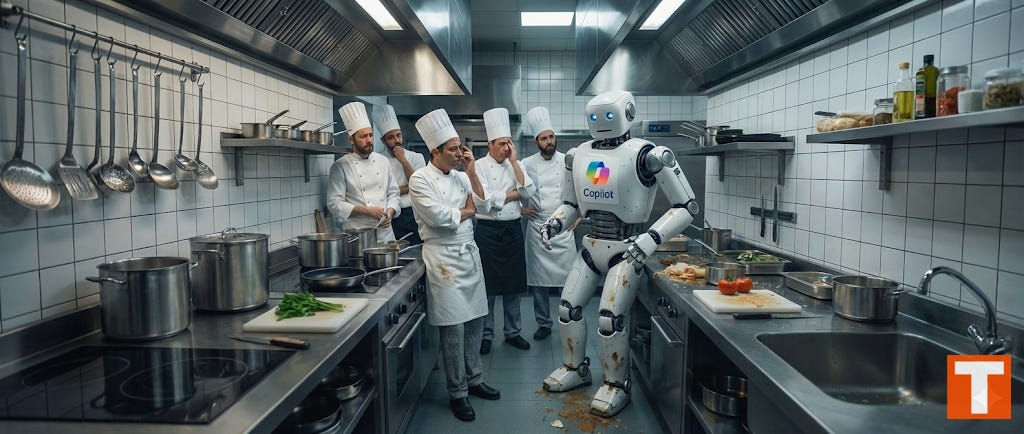
Here is a deep dive into what went wrong with the “Copilot Everywhere” strategy and why the industry is finally scaling back the garnish.
1. Clash of Flavors & Feature Bloat
The first sign of the mismatch was the user interface. Just as you wouldn’t want a sprig of thyme floating in every spoonful of lentil soup, users didn’t want a chatbot inserting itself into every keystroke.
The Nook-&-Cranny Problem
Microsoft attempted to bolt Copilot into every surface of the OS, replacing the Show Desktop button, invading the Edge sidebar, and popping up in Outlook drafts. This wasn’t feature adoption; it was encroachment.
The Opt-Out Rebellion
By early 2025, IT administrators began blocking Copilot at the network level. Why? Because it became a source of friction, not flow. The “Recall” feature, which took screenshots of user activity to build a memory bank, was the ultimate example of a feature that solved a problem nobody had while creating a privacy nightmare everyone feared.
The Verdict
When a utility tool becomes “nagware,” users stop seeing it as an assistant and start seeing it as an adversary.
2. Indigestible Ingredients
The promise of AI was to remove drudgery. The reality of 2025 has been the creation of Shadow Work, the unmeasured time humans spend fixing what the AI successfully broke.
The PowerPoint Paradox
One of the biggest selling points was “Turn this Word doc into a slide deck.” In practice, the output was often unusable—broken layouts, hallucinated summaries, and generic imagery. Users reported spending more time fixing the AI’s “first draft” than it would have taken to build the deck from a template.The 70% Failure Rate
Reports from late 2024 indicated that independent Agentic workflows failed to complete complex tasks up to 70% of the time. In a professional kitchen, if a sous-chef ruins 70% of the prep, they are fired. In software, we called it “beta” and charged $30 a month.Outcome? As you would expect.
The supposed productivity gain was an illusion. The cognitive load shifted from doing the work to auditing the machine.
3. The Garnish & Capital Inefficiency
Sambar is economical, it feeds the masses efficiently. Generative AI is capable of burning billions in capital expenses with terrifying speed.
The ROI Gap
Microsoft, along with other hyperscalers, poured tens of billions into data centers to support inference costs for features users weren’t asking for. Slashing sales targets is an admission that the market willingness to pay does not match the cost to serve.The Freemium Trap
To drive adoption numbers, Copilot was given away or bundled aggressively. But trying a feature is not the same as relying on it. When the CFO looks at the renewal bill for thousands of seats and sees that the tool is mostly used to summarize emails that should have been shorter to begin with, the budget gets cut.Economic Reality
We are realizing that LLMs are premium compute (for now, at least). Using premium compute to change the tone of an email from “casual” to “professional” is like using saffron to dye a t-shirt. It works, but it’s a tragic waste of resources.
4. Kitchen Nightmares & The Distraction of Talent
Perhaps the most damaging cost is the one we cannot see on a balance sheet: the diversion of engineering talent.
The Fragility of Complexity
Every new AI integration adds a layer of non-deterministic fragility to the software. A DNS error or a model hallucination can now break a mission-critical workflow.Hollow Seniors
We are seeing a generation of developers forced to integrate Agentic capabilities rather than fixing core architectural debt or improving system resilience. The best chefs in the kitchen were told to stop cooking and start decorating.Stalled Innovation
While Microsoft focused on the AI PC, basic frustrations with Windows search latency, update reliability, and bloat remained unaddressed.
Conclusion: Let’s Return to the Recipe
The scaling down of Microsoft Copilot is not the death of AI; it is the death of AI tourism.
The industry is waking up to the fact that you cannot simply sprinkle Intelligence on top of not-so-good software and call it a revolution.
Sambar is delicious because it respects its ingredients. Software is useful when it respects the user’s intent. The future of AI is not in the garnish, it’s in the fire that heats the pot.
It belongs in the backend, optimizing queries, defending against cyber threats, and crunching data silently.
So, it’s time to take the Rosemary out of the Sambar and let the developers get back to cooking.