

The EU AI Act indeed looks messy because it is doing something historically hard, i.e., forcing a fast-moving & kind-of-opaque-tech into a governance framework before it causes any damage, systemic or otherwise.
That alone puts it in rare company.
The closest parallel is not internet regulation or data privacy, it’s Basel banking norms. BTW, Basel I, II, III were not perfect.
They were incomplete, slow, and often gamed (Outsmarting good bankers ain’t a child’s play)
But they did one critical thing.
They turned banking risk from an abstract concept into a regulated, auditable discipline.
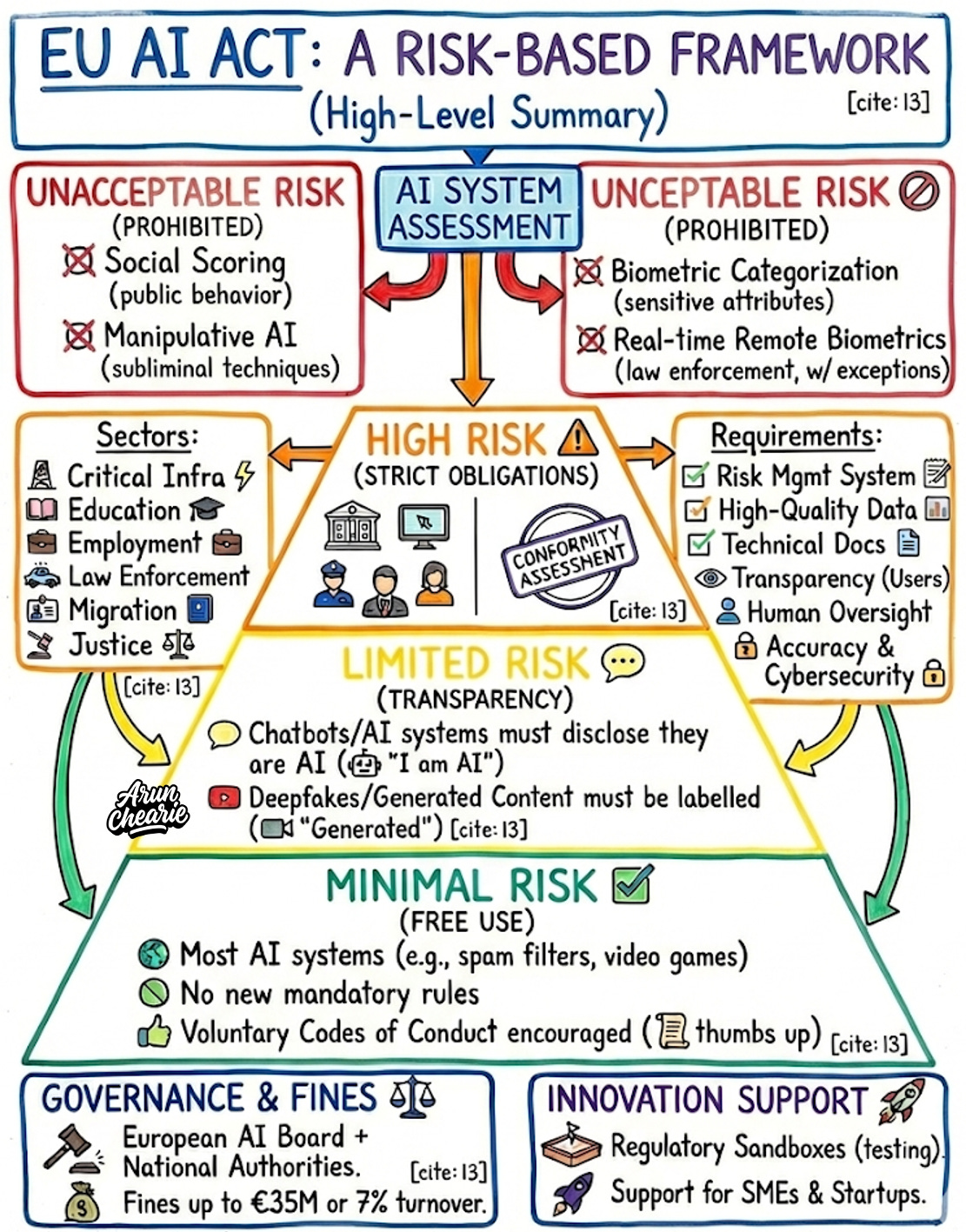
The AI Act is attempting the same move for algorithmic risk, and below is the quick whiteboard summary of what’s in store.
1. Risk-Based Regulation Is How Mature Industries Are Governed
Basel didn’t ban banking, it classified risk, assigned capital requirements, and forced documentation, stress testing, and human accountability.
The AI Act does the same
Prohibited systems ≈ activities regulators deem systemically dangerous.
High-risk systems ≈ credit underwriting, hiring, medical diagnosis are some of the touch-points where harm compounds at scale.
Low and minimal risk ≈ everyday automation left alone.
This is not innovation hostility.
It’s risk-weighted governance, the hallmark of a serious regulatory regime.
The point of regulation is not to stop innovation, but to stop tail risks from becoming systemic failures.
2. Ambiguity Is Not a Flaw, it’s the Starting Condition
Critics point to definitional ambiguity and predict years of litigation. They’re right, and that’s normal.
Basel norms evolved through enforcement, court rulings, and supervisory interpretation. No one expected Basel I to anticipate derivatives, shadow banking, or high-frequency trading. The framework hardened over time.
AI governance will follow the same trajectory.
Early uncertainty
Regulatory guidance
Case law
Industry standards
Eventually, convergence
Regulation doesn’t start precise, it becomes precise as it evolves by being used.
Static law versus evolving technology is not a contradiction, it’s a feedback loop.
3. Compliance Costs Are the Price of Trust at Scale
Yes, compliance raises costs.
So did capital requirements in banking.
So did safety certifications in aviation.
And yet,
Banking scaled because depositors trusted it.
Aviation scaled because passengers trusted it.
Pharmaceuticals scaled because regulators enforced trials.
AI is now making decisions that affect
Employment
Credit access
Healthcare outcomes
Policing and surveillance
At that point, move-fast-&-break-things is no longer a business model, it’s a liability.
If AI is deciding life-altering outcomes, it must meet life-altering standards.
4. Why AI Governance Goes Mainstream Now
AI governance didn’t become urgent because of theory, it became unavoidable because of deployment.
Three things changed.
Scale – Models now affect millions simultaneously.
Opacity – Even developers can’t fully explain outcomes.
Substitutability – AI is replacing judgment, not just assisting it.
That combination triggers the same alarm bells regulators heard in finance pre-2008:
Automated decisions
Hidden correlations
Feedback loops
Systemic bias
The moment machines make consequential decisions at scale, governance stops being optional.
5. Europe Is Playing the Long Game (Again!)
Like GDPR, the AI Act will be criticized, resisted, and slowly absorbed into global practice. Companies won’t exit the EU market—they’ll build once and deploy everywhere.
Large firms will internalize compliance.
Startups will complain, but also gain clarity on what acceptable AI means.
And just like Basel:
The first version won’t be the final one.
The rules will tighten after failures.
The framework will outlive the politics.
The EU AI Act is not the end of AI innovation, it’s the end of pretending AI has no externalities.
Bottom Line
This is not perfect regulation, it’s foundational regulation.
The AI Act is doing for algorithms what Basel did for banks:
Turning risk into something measurable
Making accountability explicit
Forcing governance to grow alongside power
It will slow some innovation, it will prevent some harm. And it will evolve, because now it has to.
History shows that industries become truly global not when they’re unregulated, but when they’re governable, think about it.
Have a good one!