

A man who has run one of the world’s largest media empires for decades falls ill on his private jet.
In the next ten minutes, several of the most powerful people in the business pick up their phones. They are his children and his closest executives. They have money, lawyers and decades of boardroom experience between them.
They have no idea what to do.
Not strategically. Practically.
Who tells the board?
Who speaks to the market?
Who has the authority to say anything at all?
One question after another gets passed along, and no one holds the answer, because for years every answer came from the man who can no longer give it.
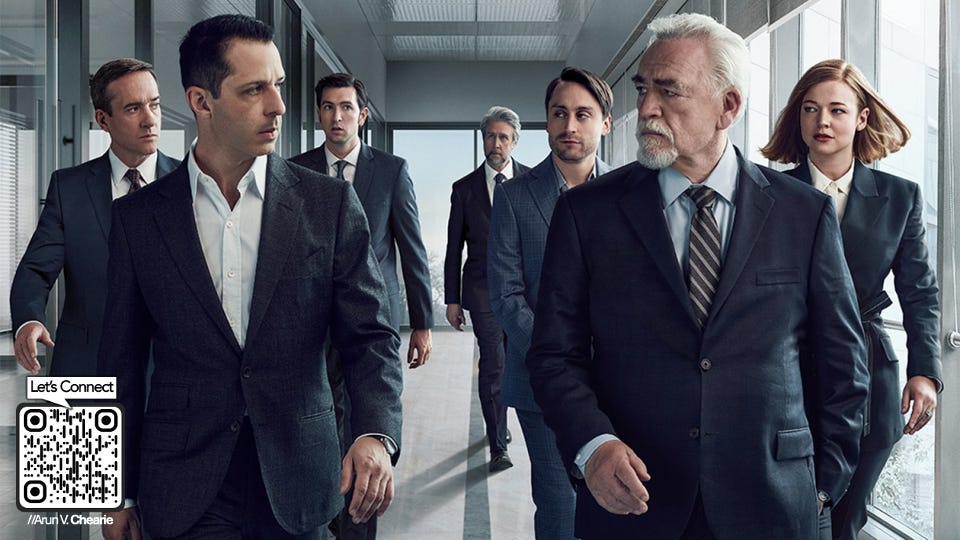
That is a scene from the final season of Succession. It is fiction. It is also one of the most accurate depictions I know of what a missing succession plan feels like from the inside.
The drama in that hour does not come from villainy. It comes from silence. The family had spent years contesting who would take the chair. They had not spent an afternoon on what happens in the first ten minutes after it empties.
Boards should watch that scene the way pilots study accident reconstructions. The question it raises is rarely who comes next. It is who is allowed to act now.
Most organisations say they have a succession plan. Fewer can show one that has been tested, and fewer still can say who would make the next hard call if their most important person were unreachable for ninety days.
That gap is the subject of this piece. It matters most in companies that have been very successful, because success hides the risk. When one person’s judgement has been right for years, the organisation reshapes itself around that judgement without anyone deciding to. Decisions drift upward. Capable people stop deciding. Everything keeps working until the day it can’t.
Concentration risk is a people risk too
Boards are trained to look for concentration risk in customers, suppliers and balance sheets. Dependence on one individual is the same kind of exposure, and it is harder to see because it looks like strength.
In organisational terms it shows up in three layers:
Decision concentration. Choices that should sit three levels down are escalated because the answer is known to be quicker at the top.
Relationship concentration. Key customers, governments, suppliers and investors trust one person rather than the institution.
Narrative concentration. The market, the press and employees see one face. When talent outside the spotlight is invisible, the board has no credible succession story to tell, and neither does anyone else.
Each layer is manageable alone. Together they create an organisation where the leader is the operating system and everyone else runs on top of it.
The span-of-control signal
One of the cleanest diagnostic indicators is the number of people reporting directly to the chief executive. Common management guidance puts senior executive spans at roughly five to ten. There are good reasons for going wider: a flat structure, highly autonomous teams, a deliberate choice to stay close to the technology. But a span of dozens is a data point worth examining.
A very wide span usually means one of two things. Either the CEO is coordinating many semi-independent units, which is a legitimate design but needs strong deputies, or the layer below has not been built to carry decisions. In both cases the number of people who can credibly step into the top role tends to be small, because few executives get the cross-company exposure a successor needs.
Span of control is a succession metric as much as an efficiency metric. If sixty teams report straight to the CEO, nobody sits in the layer where the next CEO would normally be developing.
Why the board owns this
Choosing, developing and, when necessary, replacing the chief executive is among the few responsibilities that belong to the board and cannot be delegated to management. A CEO cannot be expected to build their own replacement with full commitment, especially while performing well. The incentives point the other way. A visible successor can feel like a threat, a rival power centre, or a signal that the leader is on the way out.
That is why succession has to be a board process rather than a management courtesy. In practice, boards often fall short in four ways:
Succession is treated as an event, not a process. It reaches the agenda when a retirement is announced or a crisis hits, instead of being a standing annual discipline.
The conversation is entangled with performance. When results are strong, no director wants to look as though they are pushing the leader out. So the topic waits.
Directors meet the same five people. If the board sees executives only through the CEO’s filter, it cannot judge the bench for itself.
Founder-era governance outlives the founder-era company. Informal trust works at 200 people. It does not scale to a business with systemic importance.
When the industry is no longer just an industry
Some sectors have moved from important to infrastructural. Semiconductors are an obvious candidate, along with energy grids, payments, cloud platforms and certain categories of defence technology. When a product underpins national economies, public services and security capabilities, the company producing it carries obligations beyond those of an ordinary commercial enterprise.
It is reasonable to argue that, for a period, such companies should be governed with something closer to the continuity standards applied to banks, utilities and defence contractors. Banks, for example, are expected to maintain recovery and resolution plans, and supervisors assess whether senior individuals are fit and proper for their roles. The reasoning is simple: the failure of the institution imposes costs on people who are not its shareholders.
This is an argument about proportion, not about government control. It says that continuity of leadership, tested contingency arrangements and credible depth of talent become public goods once an industry is strategic. As the technology commoditises and supply broadens, the standard can relax. Reasonable people disagree on how far regulation should reach, and the case for lighter governance deserves a fair hearing: heavy process can slow innovation and push out the kind of leadership that created the value. The answer is governance proportionate to systemic importance, not a copy of what banks do.
What we can learn: a practical framework for boards
1. Run the ninety-day test. Ask: if the CEO were unavailable for ninety days, which decisions stop, which relationships go quiet, and who has authority to act? Write the answers down. If the list is long, the organisation has a key-person dependency, whatever the org chart says.
2. Keep two separate plans. An emergency plan covers sudden loss of the leader. It names an interim leader and sets a communications protocol, and it is reviewed every year. A planned succession covers the development of two or three internal candidates over three to five years. Many companies have only the first, and some have neither.
3. Review succession annually, outside the performance conversation. Put it on the calendar as a fixed item with its own time slot, so a good year does not postpone it and a bad year does not turn it into a verdict.
4. Give directors direct access to the layer below. Have candidates present to the board regularly, hold sessions without the CEO, and let the nominations or governance committee interview senior leaders directly. A board that sees executives only through the CEO cannot assess them independently.
5. Treat span of control as a governance metric. Ask the board to review the CEO’s direct reports each year. If the number is high, ask what structure would let decisions move down without losing quality, and who would gain the cross-functional experience a successor needs.
6. Build a visible bench, not just a private list. Encourage senior leaders to represent the company externally, with customers, regulators, investors and industry bodies. Institutional credibility should not live in one person’s reputation. This also protects the leader, who stops being the only voice.
7. Create decision rights that survive people. A clear, written map of who decides what, and within what limits, turns personal judgement into institutional capability. Test it by having someone other than the CEO run a major decision from start to finish.
8. Reassess board composition against the real risk. A skills matrix should include operational depth, regulatory and geopolitical literacy, and experience of leadership transitions in complex organisations. Consider whether a separate chair and CEO, or a strong lead independent director, gives the board the standing to raise uncomfortable questions.
9. Design the exit, not just the entry. Transitions from founders and long-tenured leaders go better when the outgoing leader has a defined role, such as adviser or chair, for a limited period, with the successor holding clear authority. Ambiguity here is where transitions fail.
10. Align incentives with building talent. If executive pay rewards only near-term results, developing a successor is a cost with no reward. Include bench strength and the retention of high-potential leaders in the criteria.
A note for leaders
None of this is a criticism of exceptional leaders. The people who build great organisations are often the ones most reluctant to step back, because their involvement has been the source of the success. The most useful thing a leader can do is invite the board to challenge the structure, and to measure their own success partly by how well the organisation functions in their absence.
An institution that depends on one person is, in a sense, still a startup, however large its market value. Maturity means the company is bigger than any individual in it.
Questions to take away
Who would make our hardest decision next month if the usual person could not?
How many people would the market, our regulators and our own employees accept as the next leader?
When did the board last meet our top fifteen leaders without the CEO in the room?
If our industry were classed as critical infrastructure tomorrow, which of our governance practices would we struggle to explain?
If you cannot answer them, you have found where to start.