

There is an uncomfortable question emerging from the Nvidia episode.
What happens to a company when the person who built it becomes more important than the institution itself?
For years, the technology industry has celebrated founders who appear irreplaceable. Their instincts are treated as strategy. Their opinions become organisational doctrine. Their presence is considered a competitive advantage. Their absence is almost unthinkable.
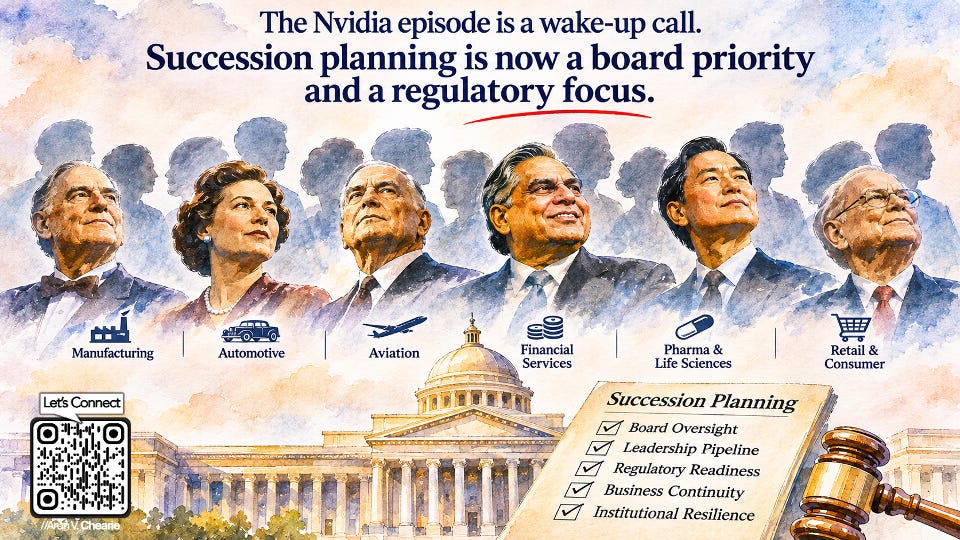
Investors reward this concentration of influence. Employees celebrate it. Boards often accommodate it. The media amplifies it.
And somewhere along the way, an unhealthy idea takes hold: that preparing for a successor somehow diminishes the founder.
It does not.
It is one of the clearest demonstrations of leadership maturity.
Nvidia’s extraordinary rise has been inseparable from Jensen Huang’s leadership. His technical instincts, strategic bets and ability to build relationships across the semiconductor ecosystem have helped shape an entire industry.
But the broader discussion raises an important governance question: how much of a strategically important enterprise’s leadership capability, institutional relationships and decision-making capacity resides in one individual?
The existence and effectiveness of succession arrangements may not be publicly known. That is precisely why the subject deserves attention.
A company of Nvidia’s economic significance cannot afford to treat leadership continuity as an afterthought.
And this is not merely an Nvidia problem.
It is a technology-industry problem.
The mythology of the indispensable founder
There is a reason founder-led companies are celebrated.
Founders often possess an unusual combination of conviction, risk appetite, product intuition and the willingness to pursue ideas that established institutions might reject.
That combination can be enormously valuable in the early years.
But the qualities that help build a company are not necessarily the qualities required to institutionalise it.
An entrepreneur who makes every important decision may accelerate a start-up. The same operating model can become a serious liability when the business employs tens of thousands, serves governments, operates critical infrastructure and influences entire economies.
Yet technology businesses have frequently treated founder dependence as a virtue.
Consider the cultural signals:-
A founder’s public appearances become market-moving events.
Employees rally around personalities rather than institutional principles.
Boards become reluctant to challenge leaders whose reputations are intertwined with the company’s valuation.
Senior executives become highly capable functional leaders but rarely receive the authority to become enterprise-wide successors.
Succession discussions are postponed because the founder is still performing exceptionally well.
The last argument is particularly dangerous.
Succession planning is not an admission that the incumbent is failing. It is an acknowledgement that the organisation must be prepared for circumstances beyond anyone’s control.
Illness, personal decisions, regulatory intervention, geopolitical developments, reputational crises or simply the passage of time can change leadership overnight.
No individual is a continuity strategy.
Hero worship is a governance problem
There is a distinction between respecting a founder and institutionalising their indispensability.
The former builds confidence. The latter creates fragility.
In mature industries, leadership is expected to operate within an institutional framework. A bank cannot allow its risk architecture to depend entirely on the judgement of its chief executive. An airline cannot make safety procedures subordinate to its most celebrated pilot. A pharmaceutical company cannot allow quality controls to disappear when its founder leaves the room.
Yet parts of the technology industry have normalised a rather different arrangement.
The founder becomes the chief strategist, chief spokesperson, chief cultural architect, principal relationship manager and sometimes the ultimate decision-maker on matters that should have independent oversight.
This creates three risks.
First, the organisation stops developing independent leadership judgement.
People learn to anticipate what the founder wants rather than challenge what the business needs.
Second, the board loses its institutional distance.
A board that cannot independently evaluate the person who built the company is not adequately performing its governance responsibilities.
Third, the next generation of leadership never gets tested.
Potential successors remain permanent number twos. They may manage large businesses but never receive the strategic authority, external exposure or crisis responsibility needed to demonstrate readiness for the top job.
A successor cannot be manufactured during a crisis.
They must be developed long before one arrives.
What centuries-old industries understands well?
The AI industry is young, but the problems it faces are not.
Banking, manufacturing, shipping, insurance, pharmaceuticals, energy and family-owned enterprises have dealt with institutional continuity for generations.
Some have learned these lessons through wars, financial crises, industrial accidents, regulatory failures and leadership transitions.
Their experience offers a valuable counterweight to the technology industry’s tendency to believe that every new business model requires an entirely new set of management principles.
Technology may change the speed of business. It does not repeal the principles of institutional survival.
Ten things to learn from established industries
1. Succession is an institutional responsibility, not a personal decision.
Boards must own the process, assess internal and external candidates, develop leadership pipelines and maintain credible emergency arrangements.
The founder should participate, but should not have unilateral control over the institution’s future.
2. Build institutions, not personality cults.
The British civil service, military institutions and large public-sector organisations demonstrate the importance of continuity beyond individual officeholders.
Institutional memory, documented processes and clearly defined authority should survive changes in leadership.
The business must know what it stands for even when its most recognisable face is absent.
3. Develop successors through apprenticeship.
Manufacturing, banking and professional services have long relied on structured exposure to increasingly complex responsibilities.
Potential successors should lead business units, manage difficult customers, navigate crises, handle capital allocation and engage with regulators.
A succession plan is not a list of names. It is a development programme backed by evidence of performance.
4. Separate ownership, governance and management.
Family-owned conglomerates and mature corporations have learned, often painfully, that these are different responsibilities.
Shareholders own the enterprise. Boards oversee it. Management operates it.
Founders can occupy more than one role, but the responsibilities must remain distinguishable.
5. Treat risk management as a core business capability.
Banks and insurance companies do not have the luxury of treating risk as a compliance exercise conducted after growth.
AI businesses should adopt the same discipline around model risk, data integrity, cybersecurity, concentration risk, supply-chain dependencies and systemic exposure.
Innovation without risk architecture eventually becomes an expensive experiment.
6. Preserve institutional memory.
Aviation and nuclear power industries understand that critical knowledge cannot reside exclusively in the minds of a handful of experienced individuals.
Decision histories, operating procedures, incident records and technical documentation matter.
AI businesses should institutionalise their architectural decisions, model evaluations, safety learnings and operational knowledge rather than allowing critical expertise to disappear with departing employees.
7. Make quality and safety non-negotiable.
Pharmaceutical and aerospace businesses understand that the cost of failure is not always captured in quarterly financial statements.
AI companies deploying systems in healthcare, financial services, public administration and critical infrastructure need similarly rigorous testing, independent validation and accountability.
A successful product launch is not evidence of long-term reliability.
8. Build relationships that belong to the enterprise.
Shipping, banking and industrial businesses have survived leadership changes because supplier relationships, customer contracts and institutional partnerships are embedded in the organisation.
In technology, too many strategic relationships are cultivated personally by founders.
Customer trust, government relationships, ecosystem partnerships and supply-chain access must be institutional assets, not personal networks that leave with an individual.
9. Allocate capital with a long-term view.
Centuries-old trading houses, insurers and industrial enterprises understand that survival requires reserves, diversification and disciplined capital allocation.
AI businesses should distinguish between productive investment and competitive spending driven by fear of missing out.
Compute expenditure, infrastructure commitments and acquisitions must be evaluated against sustainable economics.
Growth is important. The ability to finance the next decade is more important.
10. Practise stewardship across generations.
Some of the world’s longest-lived family enterprises have survived because they see themselves as custodians of an institution rather than permanent beneficiaries of it.
The responsibility is to leave the business stronger than it was inherited.
That requires leadership renewal, ethical standards, a clear purpose and a willingness to make decisions whose benefits may accrue to people who are not yet in the organisation.
This is perhaps the most important lesson of all.
A founder builds a business. A steward builds its future.
Five things the industry should stop doing
The industry also needs to confront some of its own habits. Not every practice that helped create extraordinary technology companies deserves to become a permanent management philosophy.
1. Stop confusing founder brilliance with organisational infallibility.
A founder can be an extraordinary entrepreneur and still make poor governance decisions.
Technical genius does not automatically translate into sound judgement on succession, capital allocation, people management or regulatory accountability.
Boards must be able to challenge founders without being perceived as challenging innovation itself.
2. Stop treating succession as a threat to the founder’s legacy.
There is a peculiar reluctance in some founder-led businesses to discuss what happens after the founder.
It is as if preparing a successor implies a loss of confidence in the incumbent.
The opposite is true.
A founder who deliberately develops capable successors demonstrates confidence in the organisation and in their own leadership.
Refusing to do so risks making the founder’s departure an existential event.
3. Stop rewarding growth at any cost.
The technology industry has spent much of the last two decades celebrating user acquisition, market share, valuation and scale.
The pursuit of market dominance has sometimes overshadowed profitability, operational resilience and the ability to generate sustainable returns.
AI intensifies this problem because the cost of compute, infrastructure, talent and capital can be enormous.
A business that cannot explain how its growth translates into durable economics is not necessarily building a great enterprise.
It may simply be building a very expensive position in the market.
4. Stop treating governance as a formality.
A board should not exist merely to approve decisions already made by the founder.
Independent directors need the competence, information and authority to challenge management.
Related-party interests, executive compensation, risk oversight, leadership continuity and strategic concentration require genuine scrutiny.
The more consequential a company’s role in the economy becomes, the less acceptable informal governance becomes.
5. Stop externalising the consequences of innovation.
Move fast and break things may have been an effective mantra for certain consumer internet businesses.
It is a dangerous philosophy when applied indiscriminately to financial systems, healthcare, public services, national security and critical infrastructure.
AI companies must take responsibility for the downstream consequences of their products.
Innovation cannot be an excuse for shifting the cost of failure to customers, employees, governments and society.
Why governments and regulators will increasingly care
There is another dimension to this discussion.
AI companies are no longer simply technology vendors competing for enterprise contracts.
They are increasingly becoming providers of critical economic infrastructure.
Their platforms influence financial services, national security, healthcare, education, public administration, industrial productivity and the functioning of entire digital economies.
That changes the governance equation.
When a company becomes systemically important, leadership continuity is no longer solely an internal corporate matter.
It becomes relevant to customers, investors, suppliers, governments and national economic interests.
It is reasonable to expect greater regulatory scrutiny of:
Board independence and executive accountability.
Emergency CEO succession and leadership continuity.
Concentration of decision-making authority.
Key-person dependencies in critical infrastructure.
Business continuity and operational resilience.
Conflict-of-interest management and disclosure.
Institutional readiness for unexpected leadership transitions.
This does not mean regulators should appoint successors or dictate ordinary management structures.
It means they should expect boards of systemically important enterprises to demonstrate that the business can continue operating responsibly without any one individual.
The distinction matters.
Regulation should strengthen institutional accountability, not replace entrepreneurial judgement.
The real measure of a founder’s legacy
There is a useful way to think about the next phase of the AI industry.
The first generation of technology leaders was largely judged by what they could build.
The next generation should increasingly be judged by what they can institutionalise.
Can the company innovate without the founder?
Can the board challenge management without fear?
Can the business retain its customers, partners and strategic relationships through a leadership transition?
Can it protect its employees, investors and customers during an unexpected crisis?
Can it preserve its culture without preserving every decision-making habit of its founder?
These are not questions that diminish entrepreneurship.
They are questions that separate successful businesses from enduring enterprises.
The irony is that some of the people who have built the world’s most sophisticated AI systems have been less disciplined about engineering the continuity of their own organisations.
They understand redundancy in computing, fault tolerance in infrastructure, distributed systems and resilience in software architecture.
They should apply the same thinking to leadership.
A business that has no credible alternative to its founder has a single point of failure.
And in an industry that sells resilience, intelligence and the ability to anticipate the future, that is a particularly difficult contradiction to defend.
The greatest legacy of a founder is not an enterprise that cannot function without them. It is an enterprise that does not have to.