

TL;DR:
The Bigger-is-Better parameter war is hitting diminishing returns for enterprise (AI) ROI.
Scaling-In moves focus from massive generalist models to specialized, domain-specific Small Language Models (SLMs).
Unsustainable inference costs, the need for deep domain expertise, strict data sovereignty, and the demand for real-time edge latency.
How to pivot your organization from chasing giants to building a workforce of specialists.
End of the Bigger-Is-Better Era
For the past two years, the corporate AI narrative has been held hostage by a single metric: Size.
The industry has been locked in an arms race for trillions of parameters, competing for the largest GPU clusters, and striving for a general-purpose omnipotence that borders on science fiction. The defining characteristic of the Large Language Model (LLM) boom has been brute force; more data, more compute, more power.
But a quiet, decisive shift is happening in the boardrooms of pragmatic enterprises. The “shock and awe” phase is over
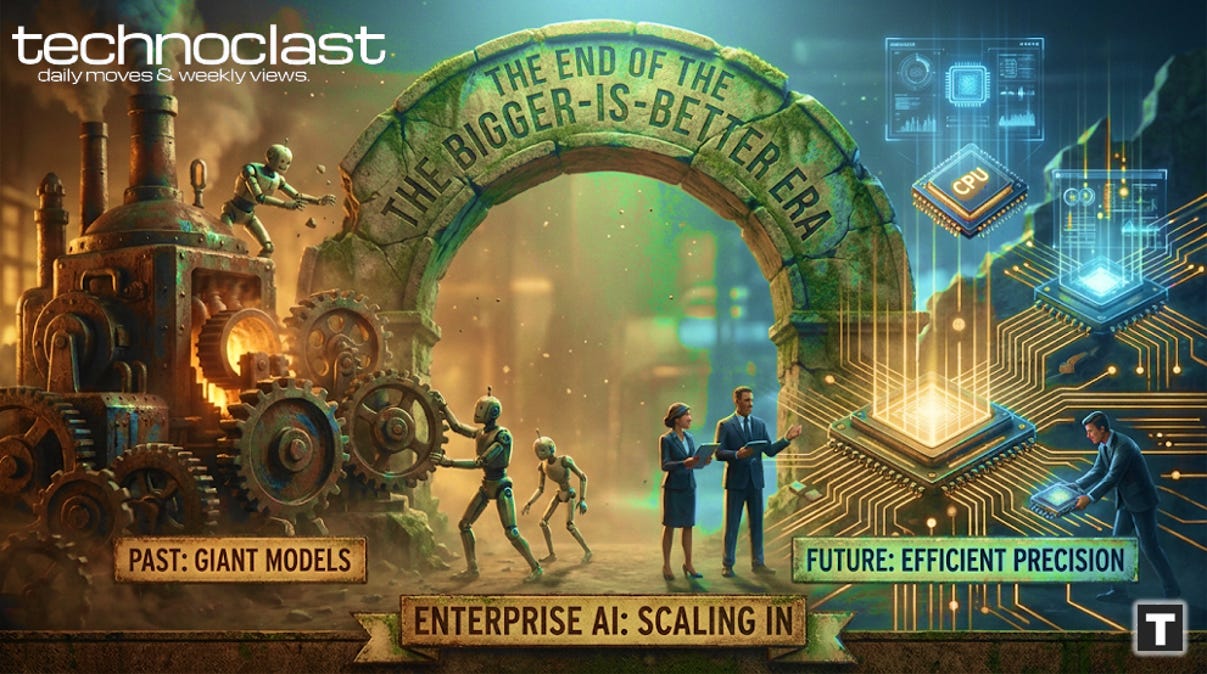
The initial hype of testing gigantic public models is wearing off, replaced by the sobering reality of what-it-takes-to-be-in-production. CIOs and CTOs are looking at their cloud bills and their latency logs, realizing that deploying a GPT-4 class model for a specific internal workflow—like analyzing legal contracts, summarizing patient records, or processing insurance claims—is an architectural mismatch.
It is akin to using a sledgehammer to crack a betel nut. It can and does work. But it is:
Expensive (burning cash on unused cognitive capacity).
Unwieldy (difficult to integrate and secure).
Indisputable Overkill.
The future of enterprise AI isn’t about scaling up further.
It’s about Scaling In.
So, What’s Scale-In?
Well! To understand Scale-In, we must first unlearn the “Scaling Laws” that have dominated AI research since 2020. We were told that performance scales linearly with parameter count and compute. While scientifically true for general intelligence, business problems are rarely general.
Scale-In is the strategic pivot from massive, generalist, public-cloud models toward smaller, highly optimized, domain-specific models deployed within controlled environments.
It is the realization that an 8-billion parameter model, trained specifically on your company’s historical financial data and vernacular, will outperform a 175-billion parameter generalist model on financial tasks and it will do so at a fraction of the cost, latency, and energy footprint.
Here is the detailed breakdown of the four pillars driving the Scale-In revolution.
1. The Sustainability of Cost (OpEx vs. CapEx)
The hardware crunch is not a temporary supply chain blip; it is the new normal. Waiting six months for H100 configurations or paying exorbitant cloud inference costs (OpEx) for every single API call is not a sustainable business model for operational AI.
When you run a generalist model, you are paying for the model’s ability to write a sonnet about a toaster, even when you only asked it to extract a date from an invoice. That is wasted compute.
The Scale-In Advantage: Scaling In utilizes advanced compression techniques to run powerful AI on commodity hardware, or even standard CPUs.
Quantization: This involves reducing the precision of the model’s calculations (e.g., from 32-bit floating point to 4-bit integers). It creates models that are 4x smaller and faster with negligible loss in accuracy.
Knowledge Distillation: This is the process of using a massive “Teacher” model to train a small “Student” model. The student learns to mimic the teacher’s reasoning for a specific task, effectively compressing the intelligence into a lightweight frame.
The Bottom Line: Instead of renting a supercomputer for every query, you run a highly efficient model on hardware you already own or cheaper cloud instances.
2. The Triumph of Specialization Over Generalization
“A jack-of-all-trades is a master of none.” It is a cliché because it is true. In the rush for AGI (Artificial General Intelligence), we forgot the value of the Specialist.
Huge LLMs are trained on the “entire internet.” They are designed to answer queries ranging from 17th-century poetry to Python debugging to lasagna recipes. They are the ultimate polymaths.
Einstein? Sure. Shakespearean? Why Not. Ramanujan? Indeed. Chomsky? Absolutely.
But your enterprise doesn’t need poetry. If you are a logistics company, you need a model that understands bills of lading, international shipping codes, and customs regulations with 99.9% accuracy. You do not need it to know who won the 1994 World Cup.
Generalist models often suffer from “distraction”—the vastness of their training data can lead to hallucinations in niche domains. By fine-tuning smaller foundation models (like Llama 3 8B, Mistral, or Microsoft’s Phi-3) on your proprietary data curation, you create a specialist.
A specialist model, trained on your documents and your edge cases, provides a depth of understanding that a generic model cannot match.
3. Data Sovereignty and the Privacy Firewall
The single biggest blocker for enterprise AI adoption remains security. For regulated industries—Finance, Healthcare, Defense, Legal—sending sensitive customer data, Intellectual Property (IP), or Personally Identifiable Information (PII) to a public model API is a non-starter.
There is a looming anxiety about:
Data Leakage: Your prompts being used to train the next version of a public model.
Regulatory Compliance: Meeting GDPR, HIPAA, or SOC2 requirements when data leaves your virtual perimeter.
The Scale-In Solution: Scale-In brings the AI to the data, not the other way around. Because these models are smaller, they can be easily containerized (using tools like Docker or vLLM) and deployed “air-gapped” on-premise or within your private Virtual Private Cloud (VPC).
You own the weights. You control the inputs. Your data never touches the public internet. This allows companies to unlock the value of their most sensitive data—financial projections, patient history, trade secrets—without the nightmare of third-party exposure.
4. Latency and the Edge Frontier
In the lab, a 3-second response time is acceptable. On the manufacturing floor or in a high-frequency trading desk, it is an eternity.
Real-time applications cannot afford the latency of a roundtrip to a massive data center. The physics of sending data to a server across the country, processing it through billions of parameters, and sending it back creates friction that breaks the user experience or misses the window of opportunity.
The Edge Advantage: Scale-In enables AI at the “Edge.”
In-Device: Running models directly on a laptop, a smartphone, or an IoT device.
Local Servers: Running inference on a local server rack in a factory.
If you are deploying AI for manufacturing line quality control (spotting defects in milliseconds), in-vehicle voice assistants (that work in tunnels without signal), or clinical decision support, speed is everything. Scaled-In models provide near-instant inference because they eliminate network latency and reduce computational drag.
Building a Workforce, Not a Tech-God.
The goal of enterprise AI is not to possess the most knowledgeable entity on the planet. The goal is to solve business problems efficiently.
We are moving away from the era of the “Chatbot” that tries to do everything, toward the era of Agentic Workflows, chains of small, specialized models working in concert. One small model extracts data, another validates it, and a third formats the output.
The leaders of the next phase of AI adoption won’t be the ones with the biggest GPU bills or the largest parameter counts. They will be the ones who master the art of Scale-In: deploying the right-sized intelligence for the right task, securely and sustainably.
It’s time to stop chasing giants. It’s time to start building specialists