

If you’ve been watching the screens this week, you’ve seen the carnage. The Nasdaq is bleeding, but for the first time in the AI era, it’s not because the technology is failing.
It’s because it’s working too well.
A Bloomberg report (link at the end) dropped today that perfectly encapsulates the panic gripping American equities: AI Angst in US Stocks Sends Global Money Chasing Asia’s Winners.
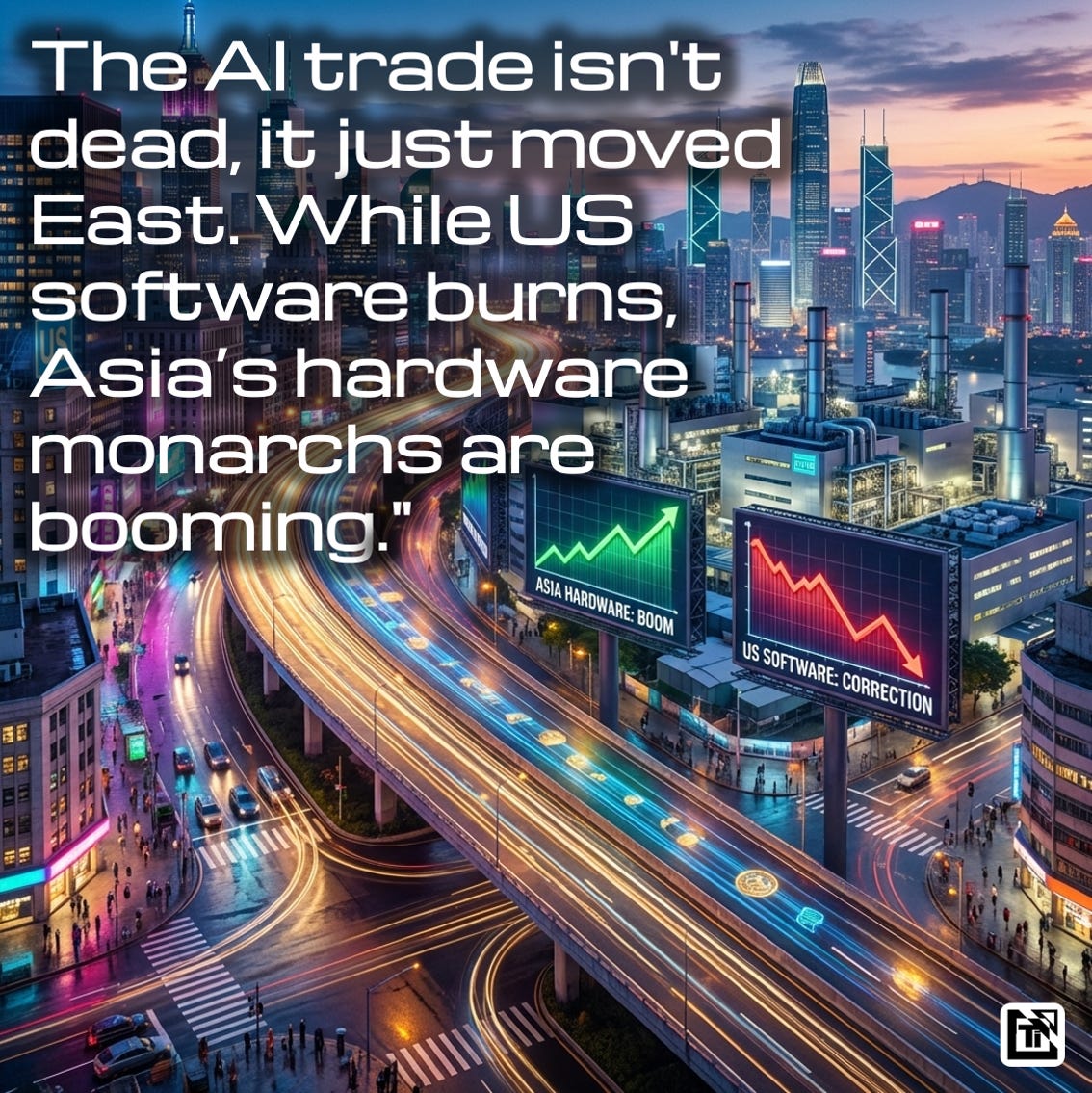
But the headline only scratches the surface. What we are witnessing is the Great Decoupling of the AI trade, a violent rotation from the software companies that use AI to the hardware giants that power it.
Here is what is happening, why the SaaS trade might be dead, and why smart money is fleeing to Seoul and Taipei.
The Trigger
You guessed it right, its Anthropic’s Claude Cowork.
The tremors started last week. The catalyst wasn’t a rate hike or a geopolitical flare-up; it was a product launch. Anthropic’s release of its Claude Cowork agent plug-ins sent a chill down the spine of every SaaS investor.
The logic is brutal and simple: If an AI agent can autonomously handle logistics, manage CRMs, and code basic stacks, why do enterprises need 50,000 seats of expensive, per-user software licenses?
Nick Ferres, CIO at Vantage Point Asset Management, gave the quote of the week, telling Bloomberg: Software stocks are now trading like banks in 2008.
The market is pricing in obsolescence. The AI Scare Trade is no longer theoretical. It is here. Investors are realizing that traditional B2B software moats are actually just shallow puddles that AI agents can step right over.
The Flight to Safety (is in Asia)
While US software burns, money isn’t going to cash, it’s crossing the Pacific.
The smart money has realized that even if AI destroys the software business model, the infrastructure requirement is non-negotiable. You can fire the SaaS vendor, but you can’t fire the GPU.
This has triggered a massive capital flight to Asia, specifically targeting the Pick and Shovel hardware monarchs:
South Korea (The Big Winner)
The Kospi Index is up 31% YTD, making it the world’s best-performing market in 2026. Samsung is being bought with both hands as memory demand for agent-based computing skyrockets.Japan & Taiwan:
Kioxia (now a top global performer) & TSMC are acting as safe havens. The thesis is simple: US tech is speculative; Asian tech is tangible.The Hardware Decoupling: Applied Materials surged 13% yesterday on an upbeat forecast. The market is screaming that building AI is still profitable, even if selling AI software is becoming a race to the bottom.
The Contagion
Yep. It’s Not Just Tech.
The most alarming part of this week’s sell-off is how far the AI Angst has spread. It has breached the containment zone of the tech sector and infected the real economy.
Commercial Real Estate (CRE) is taking a fresh beating. Office REITs tanked this week as the market connects the dots:
Better AI Agents = Fewer Knowledge Workers = Less Demand for Office Space.
If AI agents are the new junior analysts, they don’t need desks in Midtown Manhattan. This is the second derivative of the AI trade that few were hedging against.
The Contrarian View
Who is catching the knife? Retail, ofcourse!
Here is the irony. While institutional capital is fleeing US software for Asian hardware, retail investors are doing the opposite. Data shows record retail inflows into US software ETFs this week, buying the dip under the assumption that it always comes back.
This divergence, institutions selling US software to buy Asian hardware, while retail buys US software is a classic late-cycle signal. One side is betting on a return to the mean; the other is betting on a paradigm shift.
What This Means For Your Portfolio
Audit Your SaaS Exposure
If you hold companies whose primary revenue comes from per-seat licensing of productivity tools, you are in the blast zone. The market is re-rating these companies from Growth to Value Traps.Turn around & look East
The Asian hardware sector is currently the only adult in the room. They have the oligopolies (Samsung, SK Hynix, TSMC) that are protected from the software disruption wars.Watch the Spreads
Yield premiums on Asian investment-grade bonds are widening. If this rotation accelerates, we could see a liquidity crunch in US tech credit markets.
So, The AI trade isn’t over, but the Easy mode of buying any US tech stock is dead. We are moving from the hype phase to the darwinian phase. The software companies are the prey; the hardware companies are the environment. Invest accordingly.
Bloomberg Article, you need subscription: https://www.bloomberg.com/news/articles/2026-02-13/ai-angst-in-us-stocks-sends-global-money-chasing-asia-s-winners
Disclaimer:
This is not financial advice in any shape or form. I am a techno functional leader who like to read a lot and write a bit, not a wealth manager. Do your own due diligence before buying Korean or other market’ memory chip futures.
The builders of the machines are winning, while the companies making the apps are struggling to prove they are still needed.