

Every company has an AI proof of concept lying around. Very few have AI running in production, quietly doing real work every day. That gap isn’t really about model quality anymore.
It’s about a maturity gap between demoing something and depending on it.
Here’s the pattern that plays out again and again.
A team builds an impressive demo in a few weeks.
Leadership is thrilled.
Then it stalls.
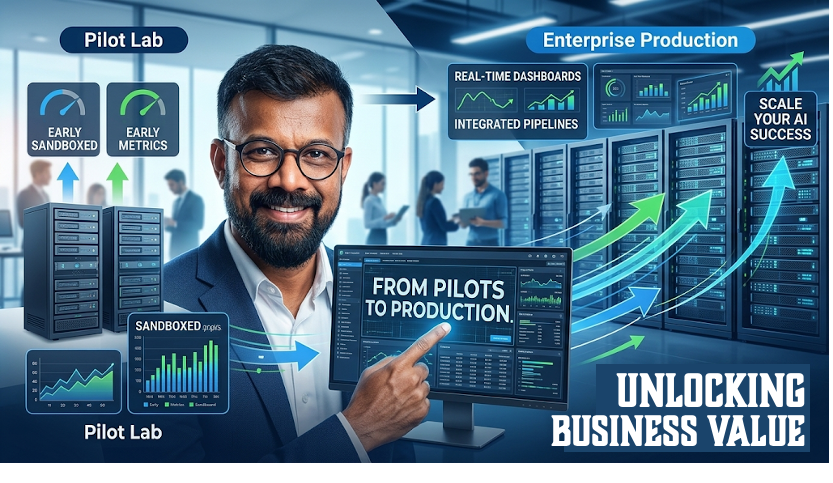
Six months later it’s still in pilot, and everyone has a slightly different theory why. The real answer is almost always the same: the POC was built to prove something could work, not to survive contact with messy data, real users and actual load.
Proof of concepts and production systems are different species of thing, even when they share the same model underneath.
A POC has to answer one question: is this possible? It gets a clean dataset, a curated demo path and an audience that wants it to succeed. Production has to answer a much harder question: will this keep working when the inputs are ugly, the volume is unpredictable and nobody is standing over it watching?
Moving from one to the other means confronting several things a POC never had to deal with.
Data plumbing, not data science
The model was rarely the actual bottleneck. The unglamorous work of pipelines, access controls, freshness and versioning is what determines whether the system can be trusted six months from now. Most teams underinvest here by an order of magnitude, because it’s invisible work that nobody demos to the board.
Evaluation as ongoing infrastructure
A demo gets judged once, by an internal audience. A production system gets judged every day by users who have no patience for drift or a confidently wrong answer. This means running structured evals continuously rather than relying on a one time impression before launch.
Designing for failure, not just success
What happens when the model is wrong and sounds completely sure of itself? Production AI needs guardrails, fallback paths and a clean handoff to a human, and these need to be designed in from day one rather than bolted on after the first embarrassing incident.
Cost and latency at real scale
The API call that’s free at fifty demo queries a day gets very real at fifty thousand. Production forces actual engineering discipline: caching, routing between models of different sizes and cost, and being honest about when you don’t need the biggest model at all.
Someone who owns it
POCs tend to be innovation team pets. Production systems need an owner who answers for uptime, cost and quality the same way they would for any other piece of critical infrastructure. If nobody is on the hook when it breaks, it stays a pilot indefinitely, because nobody has the incentive to do the hardening work.
What this looks like when it actually works?
A few anonymized but well documented deployments are instructive here, because the pattern matters more than the identity behind it.
Consider a global consumer finance platform that rolled out an AI assistant for customer service. Rather than pointing a chatbot at the support inbox and hoping, the system was scoped tightly around a defined set of tasks, measured constantly against real outcomes and given a clear escalation path to human agents whenever confidence dropped. The result, according to publicly reported figures, was an assistant handling roughly two thirds of all service inquiries, doing the equivalent work of hundreds of full time staff, while contributing tens of millions of dollars in measurable profit improvement.
A large enterprise software company offers a similar lesson from the inside.
Its own internal AI agents now resolve the large majority of customer queries end to end, and the organization was confident enough in that stability to reassign a substantial share of its support workforce into other parts of the business rather than simply cutting headcount. That reassignment detail matters more than the resolution percentage itself. It signals a system the organization trusted enough to restructure around, not one still being watched nervously from the sidelines.
There is also a useful pattern from smaller scale deployments. In one published case, a mid sized software company handling several thousand support tickets a month integrated an AI layer into its support workflow and saw a meaningful drop in overall ticket volume while resolving the majority of routine first tier inquiries without any human involvement. The interesting part isn’t the percentage. It’s that the existing support team was freed up for harder, more meaningful conversations instead of being replaced, which is usually the real difference between an AI rollout that survives contact with a real organization and one that quietly gets shelved after the first bad news cycle.
Across all of these, the common thread isn’t the vendor or the model. It’s narrow scope, continuous measurement, a genuine fallback to humans and an owner accountable for the outcome rather than just the launch.
If your AI initiative feels stuck, stop asking whether the model is good enough: Instead, Ask who owns this thing, what happens the moment it fails and how you would even know. That’s the real starting line for production, and it’s usually the question nobody wants to answer first.